

digital rotational viscometer
A digital rotational viscometer is a laboratory instrument used to measure the viscosity of fluids by determining the resistance a liquid offers to rotational movement. It is widely applied in industries such as food, cosmetics, pharmaceuticals, chemicals, coatings, and petroleum because viscosity is an important property that affects product quality, stability, processing, and performance. Compared with older mechanical models, a digital rotational viscometer provides faster readings, improved accuracy, and more convenient operation through an electronic display and control system.The basic working principle of a digital rotational viscometer is simple. A spindle or rotor is immersed in the test fluid and rotated at a controlled speed. As the spindle turns, the liquid resists the motion. This resistance creates torque, which is measured by the instrument and converted into viscosity values. The result is usually displayed in units such as centipoise (cP) or milliPascal-seconds (mPa·s), depending on the selected settings and measurement standard. Because different liquids behave differently under shear, many digital rotational viscometers allow multiple spindle choices and several rotation speeds to cover a wide range of viscosities.One of the main advantages of this instrument is its digital interface. The screen shows measurement data clearly, making it easier for users to read results and reduce human error. Many models also include programmable settings, automatic calibration functions, temperature compensation, and data storage. These features help improve repeatability and make the instrument suitable for routine quality control as well as research applications. Some versions can connect to computers or printers for data recording and analysis, which is especially useful in laboratories and production environments where traceability is important.Digital rotational viscometers are valued for their versatility. They can be used to test Newtonian fluids, which have constant viscosity, and non-Newtonian fluids, whose viscosity changes with speed or force. This makes the instrument particularly useful for materials such as creams, gels, paints, sauces, lubricants, suspensions, and polymer solutions. By measuring viscosity under different conditions, technicians can evaluate product consistency, processing behavior, and shelf stability.In practical use, the sample is usually placed in a container of suitable size and temperature. Since viscosity is highly sensitive to temperature, controlling the test environment is essential for reliable results. The spindle is then selected according to the expected thickness of the sample, and the rotation speed is set based on the test requirement. After the measurement begins, the instrument stabilizes and provides a reading once the torque becomes steady.In summary, a digital rotational viscometer is an important tool for viscosity measurement. Its electronic display, accurate performance, and flexible testing options make it useful in many scientific and industrial fields. By providing reliable viscosity data, it supports product development, process control, and quality assurance.
Products
Category:
-
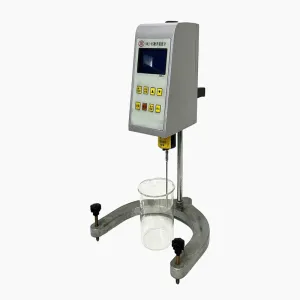
Digital Rotational Viscometer – MRX-NDJ5S
Category: Slurry ViscometersBrowse number: 4Number:Release time: 2026-09-24 19:36:01The MRX-NDJ5S is a precision digital rotational viscometer for laboratory and process-related viscosity measurement. Covering 1–100,000 mPa·s, it combines selectable spindle speeds, RTD temperature monitoring, direct digital readout, and RS232C communication for reliable evaluation of battery slurries and other industrial fluids.
News
Category:
No search results found!
Case
Category:
No search results found!
Video
Category:
No search results found!
Download
Category:
No search results found!
Job
Category:
No search results found!
Featured Products
No search results found!



 Phone
Phone