Product Introduction
The MRX-XJB-4 Small Planetary Vacuum Mixer is a compact laboratory mixing and dispersing system designed for precise preparation of battery electrode slurries and other advanced material formulations. By combining planetary movement with vacuum processing, the machine provides a controlled mixing environment that helps minimize entrapped air and supports a more consistent slurry structure. This is particularly valuable in lithium-ion battery research, where the quality and uniformity of cathode and anode slurry can directly influence subsequent coating and electrode preparation processes. The mixer is also suitable for powders, ceramic formulations and other small-batch materials that require thorough blending and controlled processing. Its compact construction makes it practical for laboratories and research facilities with limited workspace, while the integrated vacuum system eliminates the need for a separate vacuum source. With adjustable multi-stage operation, the MRX-XJB-4 allows users to establish different mixing speeds and durations for individual processing stages, providing greater control when working with materials of different viscosities and formulations.
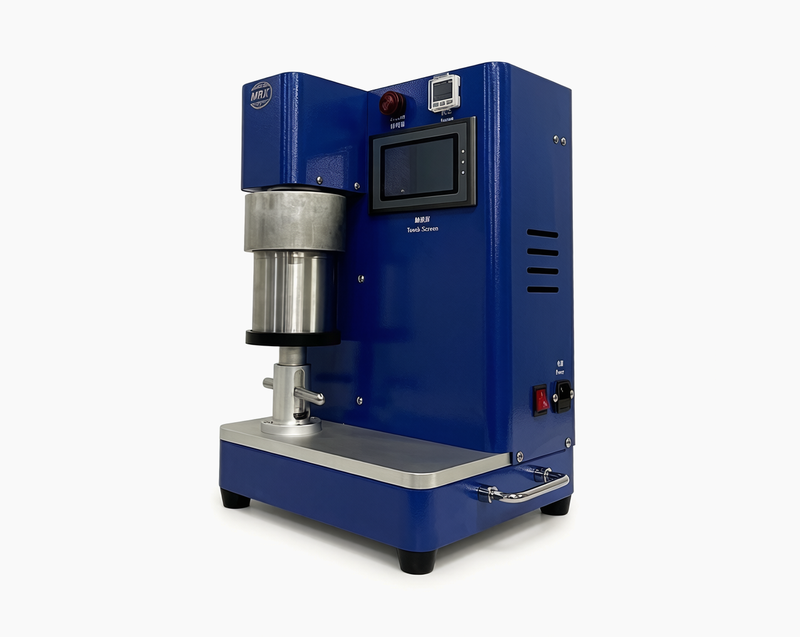
Key Specifications & Parameters
The MRX-XJB-4 operates at a maximum mixing speed of 1,400 rpm and supports three programmable speed stages for flexible process control. The mixing time can be set from 0 to 600 minutes, allowing both short laboratory trials and extended mixing cycles. The standard configuration includes a 150–500 mL stainless-steel vacuum mixing container, with alternative container configurations available according to process requirements. The machine operates on AC 220V power with a rated power of 200W. Its compact dimensions are approximately 330 × 300 × 480 mm, and the total equipment weight is approximately 23.5 kg. A dual-shaft planetary mixing structure with screw-type mixing paddles is provided as standard. The integrated vacuum system can achieve a vacuum level of approximately -0.08 MPa.
Core Features
The MRX-XJB-4 combines several functions that are important for laboratory-scale material preparation. Its planetary mixing mechanism enables the mixing components to move through different areas of the container, helping reduce localized unmixed zones during processing. Forward and reverse rotation can be selected to improve material circulation, particularly when processing relatively viscous formulations. Vacuum operation helps remove air introduced during mixing and can contribute to a more uniform slurry structure. The three-stage speed programming function enables researchers to assign different rotational speeds and processing times to individual stages rather than relying on a single fixed mixing condition. The stainless-steel mixing container provides a durable and easy-to-maintain contact surface, while the compact support structure facilitates handling and operation in laboratory environments.
Main Functions
The primary function of the MRX-XJB-4 is controlled vacuum mixing and dispersing for small quantities of research materials. In battery development, it can be used to prepare cathode and anode slurries before electrode coating. The planetary mixing action promotes material distribution throughout the batch, while vacuum processing helps reduce air entrainment. The equipment can also perform multi-stage mixing programs in which different speeds and durations are applied according to the characteristics of the formulation. Forward and reverse mixing further improve processing flexibility for materials with higher viscosity. Beyond Battery Materials, the system can be used for laboratory-scale mixing of powders, ceramic compounds and other formulations where controlled, low-air-content mixing is required.
Specific Application Scenarios
The MRX-XJB-4 is particularly suitable for lithium-ion battery research laboratories working on cathode and anode slurry preparation. It can be positioned within a laboratory-scale electrode manufacturing workflow between material formulation and subsequent coating or drying operations. Researchers can also use the machine for small-batch formulation trials when evaluating different active materials, binders, conductive additives or solvent systems. In ceramic research, the planetary vacuum mixer can support the preparation of ceramic mixtures that require thorough dispersion and reduced air content. It is also suitable for universities, battery R&D centers, pilot laboratories and material research facilities where limited batch sizes, repeatable mixing conditions and flexible process parameters are important. Its compact footprint makes it especially useful where laboratory space is restricted.
FAQ
Q1: What materials can the MRX-XJB-4 mix?
The machine is designed for laboratory-scale mixing of battery electrode slurries, powders, ceramic materials and other formulations that require planetary mixing and vacuum processing.
Q2: Can this mixer be used for lithium-ion battery electrode slurry?
Yes. The MRX-XJB-4 is specifically suitable for laboratory preparation of cathode and anode slurries used in lithium-ion battery research and electrode development.
Q3: Why is vacuum mixing important for battery slurry preparation?
Vacuum processing helps reduce air entrainment during mixing. Lower air content can contribute to a more uniform slurry structure and provide better conditions for subsequent electrode coating and processing.
Q4: Does the MRX-XJB-4 support different mixing speeds?
Yes. The mixer supports three programmable speed stages, allowing users to configure different rotational speeds and mixing times for individual processing stages.
Q5: What is the maximum mixing speed?
The maximum mixing speed is 1,400 rpm, providing sufficient flexibility for a range of laboratory mixing and dispersing requirements.
Q6: What is the standard mixing container capacity?
The standard configuration supports a 150–500 mL stainless-steel vacuum mixing container. Other container configurations can be considered according to specific process requirements.
Q7: How long can a mixing cycle be programmed?
The mixing time can be set from 0 to 600 minutes, allowing the equipment to accommodate both short experimental cycles and longer material preparation processes.
Q8: Is the vacuum system integrated into the machine?
Yes. The MRX-XJB-4 includes an integrated vacuum system, eliminating the need for a separate external vacuum pump for standard operation.



 Phone
Phone