Product Introduction
The MRX-ZKJB-5 Cup-Type Vacuum Mixer is a compact laboratory mixing solution developed for small-volume material preparation where controlled mixing and reduced air entrainment are important. It integrates mechanical mixing, dispersion and vacuum processing into one compact system, making it suitable for research involving battery electrode slurries, ceramic formulations, powders and other functional materials. During operation, the material is mixed inside a sealed container under vacuum, helping reduce air introduced into the formulation and supporting a more uniform material structure. The machine uses a single-shaft paddle mixing configuration and supports forward and reverse rotation, allowing the operator to adjust the mixing approach according to the characteristics of the material. Its small footprint and integrated vacuum system make it particularly suitable for laboratories, universities, battery research facilities and other environments where experimental batches are relatively small and workspace efficiency is important.
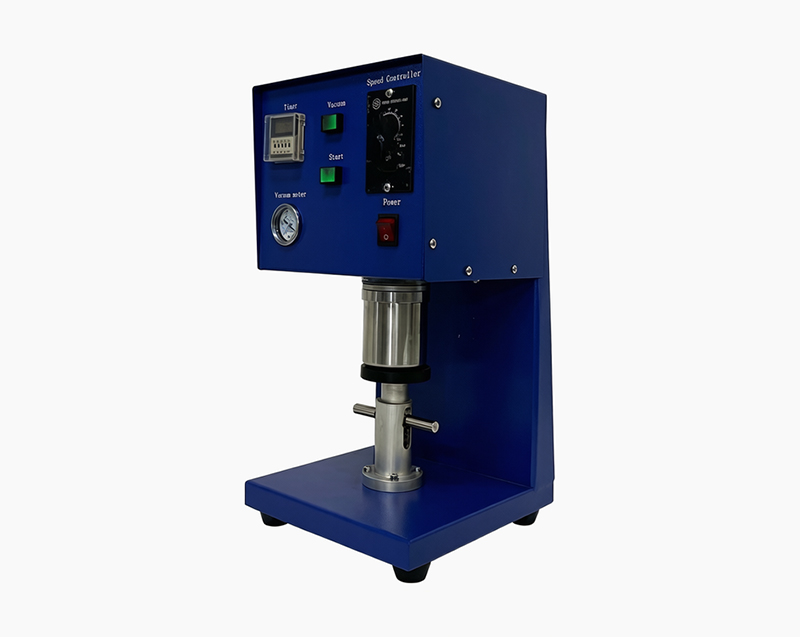
Key Specifications & Parameters
The MRX-ZKJB-5 is rated at 150W and operates with a 220V power supply. Its standard mixing speed is 320 rpm, providing a controlled rotational condition for laboratory-scale slurry and material preparation. The machine uses a single-shaft paddle-type mixing blade and can achieve a vacuum level of better than -80 kPa. The standard configuration includes one 150–250 mL mixing container, while other container capacities can be considered according to specific customer requirements. A vacuum gauge and vacuum connection are integrated into the machine for monitoring and operation. The equipment measures approximately 250 × 300 × 490 mm and weighs about 15 kg. The built-in timer supports adjustable operation from 0 to 99.99 hours, providing greater flexibility for extended laboratory mixing experiments.
Core Features
The MRX-ZKJB-5 is designed around the needs of small-volume laboratory material processing. Its vacuum-assisted configuration helps reduce trapped air during mixing, which is especially useful when preparing electrode slurry or other formulations where air bubbles can interfere with subsequent processing. Forward and reverse rotation gives researchers greater flexibility when handling materials with different flow characteristics. The single-shaft paddle structure provides a straightforward and reliable mixing mechanism while keeping the overall equipment compact. The integrated vacuum system eliminates the need for a separate standard vacuum source, simplifying laboratory installation. A built-in timing function also allows users to establish longer unattended mixing cycles when required. The compact enclosure and lightweight construction make the machine easy to position, operate and integrate into laboratory workflows.
Main Functions
The main function of the MRX-ZKJB-5 is vacuum-assisted mixing for small batches of research materials. In lithium-ion battery development, it can be used for laboratory preparation of cathode and anode electrode slurries before coating and electrode fabrication. The vacuum environment helps reduce air incorporation during the mixing process, supporting more consistent slurry preparation. The equipment can also be used for blending powders, ceramic materials and other experimental formulations that benefit from controlled mixing under reduced pressure. Forward and reverse operation provides additional process flexibility, while the adjustable timer allows researchers to reproduce defined mixing cycles during material formulation studies and comparative experiments.
Specific Application Scenarios
The MRX-ZKJB-5 is particularly appropriate for lithium-ion battery laboratories conducting small-batch electrode material experiments. It can be used during the slurry preparation stage when researchers evaluate different cathode or anode formulations before moving to laboratory coating equipment. Battery R&D centers can also use the machine for formulation screening, process parameter comparison and preliminary material testing. In ceramic research, its vacuum mixing capability can assist with preparing small quantities of ceramic compounds where minimizing entrapped air is desirable. The equipment can also support university laboratories, material science research centers and pilot-scale development environments working with limited quantities of functional materials. Its compact 15 kg structure makes it practical for laboratories where equipment footprint and ease of relocation are important considerations.
FAQ
Q1: What is the MRX-ZKJB-5 designed for?
The MRX-ZKJB-5 is designed for small-volume vacuum mixing and dispersion of battery electrode slurries, ceramic materials, powders and other laboratory formulations.
Q2: Can this vacuum mixer be used for lithium-ion battery slurry?
Yes. The machine is suitable for laboratory preparation of cathode and anode slurries used in lithium-ion battery research and electrode development.
Q3: What is the benefit of mixing under vacuum?
Vacuum mixing helps reduce air entrainment during material processing. This can support a more uniform slurry structure and provide better conditions for subsequent coating and electrode preparation.
Q4: What is the standard mixing speed of the MRX-ZKJB-5?
The standard mixing speed is 320 rpm. The actual mixing condition can be selected according to the formulation and process requirements.
Q5: What is the standard container capacity?
The standard configuration includes one 150–250 mL mixing container. Alternative container configurations can be considered according to specific customer requirements.
Q6: What vacuum level can the machine achieve?
The specified vacuum level is better than -80 kPa, providing a reduced-pressure environment for laboratory mixing and material preparation.
Q7: Does the mixer support forward and reverse rotation?
Yes. Forward and reverse mixing operation provides additional process flexibility when working with different material formulations and mixing requirements.
Q8: How long can the mixing process be programmed?
The built-in timer can be set from 0 to 99.99 hours, allowing the machine to support both short experiments and extended laboratory mixing cycles.
Q9: Is the vacuum system included with the machine?
Yes. The machine is equipped with an integrated vacuum system and includes a vacuum gauge and vacuum connection for operation and monitoring.
Q10: Is the MRX-ZKJB-5 suitable for laboratories with limited space?
Yes. With dimensions of approximately 250 × 300 × 490 mm and a weight of about 15 kg, the compact design is well suited to laboratory environments where available floor space is limited.



 Phone
Phone