Product Introduction
The MRX-GL-1 Laboratory Battery Slurry Filtration Unit is designed for fine filtration of electrode slurry during laboratory-scale battery material preparation. It is particularly suited to research environments where slurry cleanliness and particle control can influence the quality and consistency of subsequent electrode coating.
The unit uses a vacuum-assisted filtration process to draw slurry through a selected filter screen. This approach allows researchers to remove unwanted coarse particles and agglomerates before the slurry enters the electrode coating stage.
For lithium-ion battery research, filtration can be an important intermediate step between slurry preparation and electrode coating. Removing oversized particles or poorly dispersed material can help improve slurry consistency and reduce the risk of surface defects during subsequent coating operations.
The MRX-GL-1 supports filtration of both cathode and anode slurry formulations. It is supplied with 80, 100, and 150 mesh filter screens, while alternative screens below 1,000 mesh can be selected according to the required filtration process.
The entire filtration assembly is constructed from SUS304 stainless steel, providing a cleanable and corrosion-resistant material-contact structure. With a 500 mL capacity and a compact overall configuration, the MRX-GL-1 is particularly suitable for laboratory-scale battery research and small-batch electrode development.
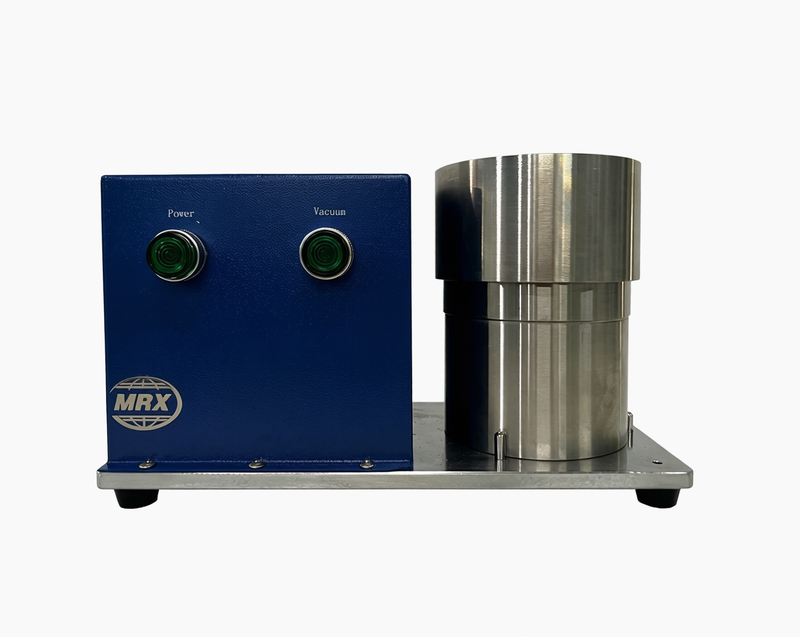
Key Specifications & Parameters
Product Model: MRX-GL-1
Product Type: Battery Slurry Filtration Unit
Filtration Method: Vacuum suction filtration
Power Supply: AC 220 V ±10%, 50 Hz
Absolute Vacuum: 65 kPa
Operating Vacuum: ≥65 kPa
Air Pump Flow Rate: 3 L/min
Filtration Capacity: 500 mL
Standard Filter Screens: 80, 100, and 150 mesh
Optional Filter Screens: Below 1,000 mesh
Recommended Slurry Viscosity: ≤20,000 cP
Recommended Solid Content: ≤80%
Filter Construction: SUS304 stainless steel
Filter Dimensions: 140 × 150 × 200 mm
Vacuum Generator Dimensions: 140 × 70 × 150 mm
Equipment Weight: Approximately 4 kg
The filtration system is designed around a relatively large effective filtration area to maintain low pressure loss during operation. Filter selection should be matched to the slurry formulation, particle characteristics, and desired downstream coating requirements.
Core Features
Fine Particle Filtration
The MRX-GL-1 is designed for laboratory-scale removal of unwanted particles and agglomerates from battery electrode slurry. The available filter configurations allow researchers to select an appropriate filtration level for different formulations.
Vacuum-Assisted Filtration
Instead of relying solely on gravity, the unit uses vacuum suction to move slurry through the filtration medium. This provides a controlled filtration process and makes the system suitable for laboratory materials that require more efficient slurry handling.
Flexible Filter Selection
The standard configuration includes 80, 100, and 150 mesh screens, while optional filtration screens below 1,000 mesh can be selected for applications requiring finer filtration.
SUS304 Stainless Steel Construction
The slurry-contact components use SUS304 stainless steel. This construction supports routine cleaning and provides good corrosion resistance for laboratory material processing environments.
Large Filtration Area
The filtration structure provides a relatively large effective filter area, helping maintain lower pressure loss while processing slurry. This design is useful for maintaining stable filtration performance during laboratory operation.
Compact Laboratory Design
The filtration unit measures only 140 × 150 × 200 mm, while the vacuum generator measures 140 × 70 × 150 mm. The compact configuration allows the system to fit easily into battery material preparation areas and laboratory workstations.
Easy Operation and Maintenance
The straightforward filtration structure allows researchers to change filter screens and clean the material-contact components without complex maintenance procedures.
Main Functions
Electrode Slurry Filtration
The primary function of the MRX-GL-1 is to filter battery electrode slurry before downstream electrode processing. It can be incorporated into laboratory workflows for cathode and anode material preparation.
Removal of Coarse Particles and Agglomerates
Filtration can help separate unwanted larger particles or agglomerated material from a prepared slurry. This can contribute to more consistent slurry quality before coating.
Slurry Quality Optimization
By controlling the particle fraction entering the coating process, the MRX-GL-1 can support more stable slurry preparation and help researchers improve the consistency of subsequent electrode coatings.
Vacuum Suction Processing
The integrated vacuum generation system provides the suction force required to pull slurry through the selected filter medium.
Small-Batch Material Processing
With a 500 mL capacity, the unit is intended for laboratory-scale quantities rather than high-volume industrial slurry processing. This makes it suitable for formulation development and small experimental batches.
Specific Application Scenarios
Lithium-Ion Battery Electrode Research
The MRX-GL-1 can be placed between slurry preparation and electrode coating in lithium-ion battery laboratory workflows. Researchers can use it to treat experimental cathode and anode formulations before coating.
Cathode Slurry Preparation
Cathode formulations containing active materials, conductive additives, and binders can contain unwanted agglomerates if the dispersion process is not fully optimized. Vacuum filtration provides an additional material-control step before coating.
Anode Slurry Preparation
The filtration unit can also be applied to anode slurry preparation where particle and agglomerate control is important for consistent laboratory electrode fabrication.
Electrode Coating Research
For laboratories investigating coating performance, controlled slurry filtration can help reduce the presence of oversized particles that may contribute to coating defects or non-uniform surfaces.
Battery Material Formulation Development
Researchers developing new slurry compositions can use different filter mesh sizes to investigate how filtration affects slurry processing and subsequent electrode quality.
University Battery Research Laboratories
The compact size, 500 mL capacity, and straightforward operation make the MRX-GL-1 suitable for university laboratories and research institutes performing small-batch battery material experiments.
Battery Pilot Process Development
During early pilot-process development, the unit can be used as a laboratory filtration stage to evaluate slurry handling requirements before transitioning to larger-capacity filtration equipment.
Frequently Asked Questions
1. What is the MRX-GL-1 used for?
The MRX-GL-1 is designed for laboratory-scale filtration of battery electrode slurry. It is primarily used to remove unwanted particles and agglomerates before subsequent electrode coating or cell fabrication processes.
2. Can the MRX-GL-1 filter both cathode and anode slurry?
Yes. The unit is designed to support filtration of both cathode and anode slurry formulations. The appropriate filter mesh should be selected according to the characteristics of the specific slurry.
3. What filter screens are included with the MRX-GL-1?
The standard configuration includes 80, 100, and 150 mesh filter screens. Optional filter screens below 1,000 mesh are also available according to the required filtration specification.
4. What is the filtration capacity?
The MRX-GL-1 has a 500 mL filtration capacity, making it suitable for laboratory-scale slurry preparation and small-batch material experiments.
5. How does vacuum filtration work in this system?
The integrated vacuum generator creates suction that draws the slurry through the selected filter screen. The filtration medium retains unwanted particles while the processed slurry passes through for subsequent use.
6. What slurry viscosity is recommended?
The recommended slurry viscosity is ≤20,000 cP, with a recommended solid content of ≤80%. Actual filtration performance depends on slurry formulation, particle characteristics, viscosity, and selected filter mesh.
7. What material is used for the filtration unit?
The filtration system uses SUS304 stainless steel, providing good corrosion resistance and making the material-contact components suitable for repeated laboratory cleaning.
8. What vacuum level can the MRX-GL-1 achieve?
The specified absolute vacuum is 65 kPa, with a vacuum level of ≥65 kPa according to the supplied technical specifications.
9. Is the MRX-GL-1 suitable for industrial-scale slurry production?
The MRX-GL-1 is primarily designed for laboratory and small-batch applications. Its 500 mL capacity makes it more appropriate for battery R&D, material formulation studies, and process development than high-volume production.
10. Can the filter mesh be changed for different experiments?
Yes. The filtration system supports different mesh configurations, allowing researchers to adjust the filtration level according to the slurry formulation and experimental requirements.



 Phone
Phone