Product Introduction
The MRX-XJB-4 Small Planetary Vacuum Mixer is designed for laboratory-scale material preparation where mixing uniformity, air removal, and process control are essential. The system combines planetary mixing with an integrated vacuum environment, allowing materials to be processed while reducing air incorporation during mixing.
For lithium-ion battery research, the mixer is particularly suitable for preparing cathode and anode slurries before electrode coating. The planetary mixing mechanism is designed to handle relatively viscous formulations while maintaining effective material circulation throughout the mixing vessel.
The vacuum-assisted process helps reduce air trapped within the material during preparation. This is valuable when researchers need a more homogeneous slurry for subsequent electrode processing and laboratory cell fabrication.
Beyond battery research, the MRX-XJB-4 can also be used for powder-based formulations, ceramic materials, and other laboratory materials requiring controlled high-viscosity mixing. Its compact design makes it suitable for research laboratories where equipment footprint and process flexibility are important considerations.
With a maximum mixing speed of 1,400 rpm, programmable three-stage operation, and an integrated vacuum pump capable of reaching approximately -0.08 MPa, the MRX-XJB-4 provides researchers with greater control over laboratory mixing procedures.
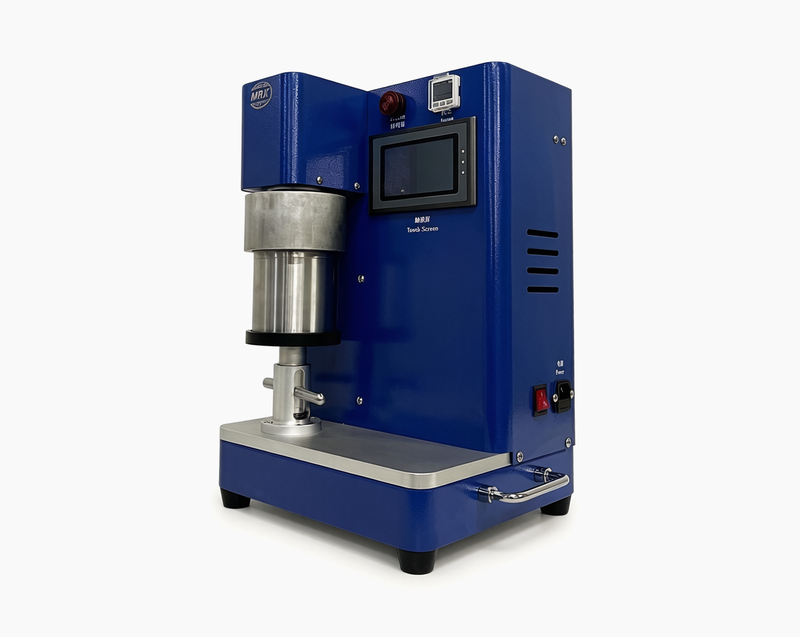
Key Specifications & Parameters
Product Model: MRX-XJB-4
Equipment Type: Small Planetary Vacuum Mixer
Maximum Mixing Speed: 1,400 rpm
Mixing Program: Three-stage speed and time programming
Mixing Time: 0–600 minutes, programmable
Standard Mixing Vessel: 150–500 mL stainless steel vacuum mixing vessel
Alternative Vessel Configuration: Other vessel specifications can be configured according to application requirements
Mixing Structure: Dual-shaft planetary mixing system
Mixing Blade: Standard screw-type planetary mixing blades
Vacuum System: Integrated vacuum pump
Maximum Vacuum Level: Approximately -0.08 MPa
Power Supply: AC 220 V
Rated Power: 200 W
Overall Dimensions: 330 × 300 × 480 mm
Equipment Weight: 23.5 kg
The standard configuration uses a dual-shaft planetary mixing structure with screw-type mixing blades. Different mixing shaft configurations can be selected according to the size and design of the mixing vessel.
Core Features
Dual-Shaft Planetary Mixing
The MRX-XJB-4 uses a dual-shaft planetary mixing configuration designed to improve material circulation within the vessel. This structure is particularly useful for laboratory formulations where conventional single-axis mixing may not provide sufficient movement through higher-viscosity materials.
Vacuum-Assisted Mixing
An integrated vacuum system allows the mixing process to take place under reduced pressure. Removing air during mixing can help minimize bubbles incorporated into the slurry and improve the consistency of the prepared material.
High-Speed Mixing for Viscous Materials
With a maximum speed of 1,400 rpm, the mixer provides sufficient rotational capability for laboratory formulations with relatively high viscosity. The planetary movement helps distribute the material throughout the mixing vessel during processing.
Programmable Three-Stage Operation
The MRX-XJB-4 supports three programmable mixing stages. Researchers can set different speeds and operating times for individual stages, allowing multi-step mixing procedures to be adapted to specific material formulations.
Flexible Mixing Vessel Configuration
The standard system supports a 150–500 mL stainless steel vacuum mixing vessel. Other vessel configurations can be accommodated according to the required container volume and mixing application.
Compact Laboratory Footprint
Measuring only 330 × 300 × 480 mm, the MRX-XJB-4 is designed for laboratory environments where bench and floor space may be limited. Its compact structure allows it to be incorporated into battery research and material preparation workflows without requiring a large equipment area.
Integrated Vacuum System
The built-in vacuum pump eliminates the need for a separate external vacuum source in the standard configuration. The system can reach approximately -0.08 MPa, providing controlled vacuum conditions during material mixing.
Main Functions
Battery Electrode Slurry Preparation
The primary application of the MRX-XJB-4 is the preparation of cathode and anode slurries used in lithium-ion battery research. The combination of planetary mixing and vacuum processing helps researchers obtain a more consistent material formulation before electrode coating.
Material Homogenization
The planetary mixing motion promotes continuous material movement within the vessel, supporting uniform distribution of powders, binders, solvents, and other formulation components.
Air Removal During Mixing
Vacuum processing reduces the amount of air retained in the material during mixing. This is particularly useful for formulations where entrapped bubbles could negatively affect subsequent processing.
High-Viscosity Material Mixing
The dual-shaft planetary structure is suitable for laboratory formulations that require stronger mixing action than conventional low-speed laboratory stirrers can provide.
Multi-Stage Mixing Processes
Researchers can create sequential mixing programs using different rotational speeds and durations. This allows the same equipment to support different material preparation procedures without manually changing the process between every stage.
Ceramic and Powder Material Processing
In addition to Battery Materials, the mixer can be applied to selected ceramic formulations and powder-based materials that require controlled laboratory-scale mixing under vacuum.
Specific Application Scenarios
Lithium-Ion Battery Research Laboratories
The MRX-XJB-4 can be integrated into lithium-ion battery laboratory workflows for preparing cathode and anode slurries before electrode coating. It can serve as the mixing stage between raw material preparation and electrode fabrication.
Battery Electrode Development
Researchers developing new electrode formulations can use the mixer to prepare small batches of material under controlled speed, time, and vacuum conditions. This is particularly suitable for experimental work where formulation quantities are limited.
New Battery Material Evaluation
When laboratories compare different active materials, binders, conductive additives, or formulation ratios, a small-capacity vacuum mixer can help prepare experimental batches without requiring large-scale production equipment.
Solid-State Battery Research
For selected solid-state battery material formulations, controlled laboratory mixing can be an important step before electrode or cell preparation. The MRX-XJB-4 can be incorporated into appropriate material preparation workflows where its vacuum mixing capability matches the formulation requirements.
Ceramic Material Research
The planetary mixing structure can also support laboratory preparation of ceramic formulations and other powder-based materials that require intensive and homogeneous mixing.
University and Research Institute Laboratories
The compact dimensions and relatively small vessel capacity make the MRX-XJB-4 suitable for university laboratories, research institutes, battery technology centers, and other R&D environments working with small material batches.
Battery Pilot-Line Development
The MRX-XJB-4 can also serve as a laboratory mixing unit during early-stage process development before a battery research project advances toward larger-scale slurry preparation and pilot production.
Frequently Asked Questions
1. What is the MRX-XJB-4 used for?
The MRX-XJB-4 is primarily used for laboratory-scale vacuum mixing and dispersion of battery electrode slurries. It can also be used for selected powder, ceramic, and other high-viscosity material formulations.
2. Can the MRX-XJB-4 mix cathode and anode slurries?
Yes. The equipment is designed for laboratory preparation of both cathode and anode slurry formulations used in battery research. The appropriate mixing process should be selected according to the material composition and viscosity.
3. What is the maximum mixing speed of the MRX-XJB-4?
The maximum mixing speed is 1,400 rpm. The equipment also supports multi-stage operation, allowing different mixing speeds and durations to be programmed for separate process stages.
4. Does the MRX-XJB-4 have a built-in vacuum system?
Yes. The MRX-XJB-4 includes an integrated vacuum pump. The system can achieve a vacuum level of approximately -0.08 MPa.
5. What is the standard capacity of the mixing vessel?
The standard configuration includes a 150–500 mL stainless steel vacuum mixing vessel. Other vessel specifications can be considered according to the required application and vessel design.
6. How does vacuum mixing benefit battery slurry preparation?
Vacuum mixing helps reduce air trapped in the slurry during the mixing process. Lower air incorporation can contribute to more consistent material preparation and help reduce bubble-related issues during subsequent electrode processing.
7. Can the mixing process be programmed?
Yes. The MRX-XJB-4 supports three-stage mixing programs. Each stage can be configured with its own mixing speed and operating time.
8. Is the MRX-XJB-4 suitable for high-viscosity materials?
Yes. Its planetary dual-shaft mixing configuration is designed to provide effective movement of relatively high-viscosity laboratory formulations. Actual suitability depends on the material properties and formulation.
9. What is the footprint of the MRX-XJB-4?
The equipment measures 330 × 300 × 480 mm and weighs approximately 23.5 kg, making it suitable for laboratories with limited installation space.
10. Can the MRX-XJB-4 be used for applications other than battery materials?
Yes. In addition to battery electrode slurry preparation, the mixer can be used for selected ceramic and powder-based material formulations that require planetary mixing and vacuum processing.



 Phone
Phone