Ultrasonic Metal Tab Spot Welder MRX-DH1000
Product Introduction
The Ultrasonic Metal Tab Spot Welder MRX-DH1000 is a compact ultrasonic welding system designed for metal joining applications in battery cell manufacturing and research. It is particularly suitable for welding metal tabs and sheet components used in both winding and stacking cell assembly processes. By applying high-frequency mechanical vibration to the contact interface, the system creates a solid-state bond without relying on conventional soldering materials.
The MRX-DH1000 operates at a nominal ultrasonic frequency of 40 kHz. Its ultrasonic transducer converts electrical oscillation into mechanical vibration, which is transferred through the welding tool to the metal interface. The resulting frictional interaction and localized deformation promote bonding between the contacting metal surfaces while minimizing the need for external heat input.
Unlike conventional fusion welding processes, ultrasonic metal welding can join suitable conductive materials without adding solder, flux, or other consumables. The process is designed to produce compact and conductive joints while limiting thermal influence on the surrounding material. This makes ultrasonic welding particularly useful when electrical conductivity, joint cleanliness, and controlled thermal exposure are important.
The welding time can be adjusted within a range of 0–1 second, allowing the operator to establish a suitable process window according to the material combination, thickness, joint configuration, and required welding performance. The short cycle time also makes the equipment suitable for repetitive laboratory and pilot-scale battery welding operations.
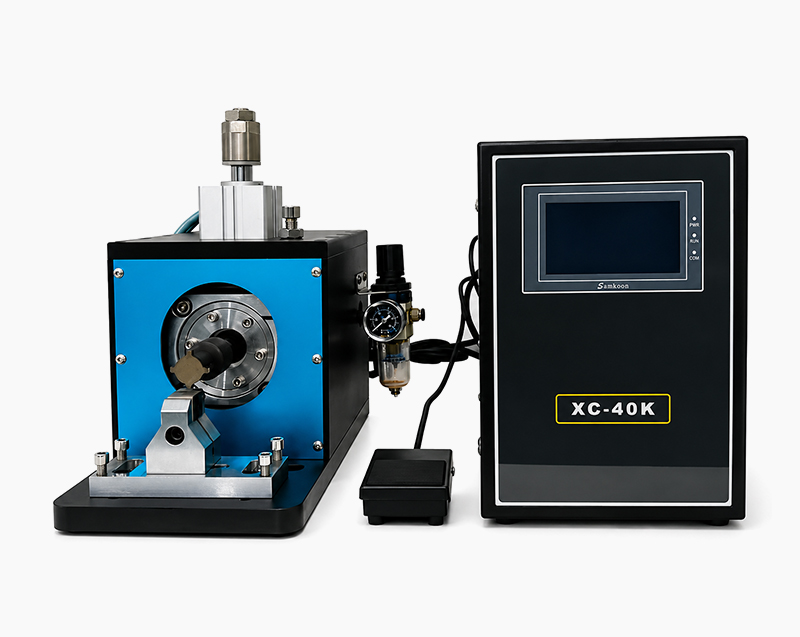
The MRX-DH1000 features a compact structure and separate control and generator units, providing practical installation and operation for battery laboratories, cell development facilities, and small-scale production environments. Its design emphasizes stable operation, convenient maintenance, and controlled ultrasonic energy delivery.
For battery R&D applications, the MRX-DH1000 can be integrated into electrode and cell assembly workflows where metal tabs or conductive sheet components need to be joined rapidly and with minimal additional materials. It is especially relevant to pouch cell development and other battery formats using tab-based electrical connections.
Key Specifications & Parameters
Product Name: Ultrasonic Metal Tab Spot Welder
Model: MRX-DH1000
Maximum Input Power: 0–1000 VA
Welding Time: 0–1 second
Ultrasonic Frequency: 40 kHz
Power Supply: AC 220 V / 50 Hz
Working Pressure: 0.5–0.7 MPa
Control Box Dimensions: 360 × 480 × 200 mm
Generator Dimensions: 300 × 460 × 270 mm
Equipment Weight: 35 kg
Core Features
40 kHz Ultrasonic Welding Technology
The MRX-DH1000 uses 40 kHz ultrasonic vibration to generate mechanical energy at the metal interface. This enables rapid solid-state joining of suitable metal components without depending on traditional thermal fusion techniques.
Short Welding Cycle
With a welding time range of 0–1 second, the system supports rapid joining cycles. This short processing time is beneficial for repetitive battery tab welding and laboratory cell assembly operations.
Low Thermal Influence
Because the bonding mechanism relies primarily on ultrasonic mechanical vibration rather than conventional high-temperature melting, the process can reduce thermal exposure around the welding area when appropriate parameters and materials are used.
No Solder or Flux Required
Suitable metal combinations can be joined without conventional solder, flux, or additional welding consumables. This simplifies the process and helps maintain a clean welding environment.
Low Electrical Joint Resistance
The ultrasonic joining process is designed to create conductive metal-to-metal connections with low electrical resistance, making it suitable for battery tab and other conductive connection applications where electrical performance is important.
Compact Equipment Configuration
The compact equipment configuration is convenient for battery laboratories and pilot production environments where available installation space may be limited.
Stable and Convenient Operation
The robust construction and dedicated ultrasonic generator are designed to provide stable energy delivery during repeated welding operations while keeping operation and maintenance straightforward.
Main Functions
Battery Tab Welding
The primary function of the MRX-DH1000 is joining metal battery tabs and conductive sheet components during cell assembly. It provides a fast ultrasonic bonding method for suitable metal combinations.
Metal Sheet Joining
The equipment can be used for ultrasonic joining of compatible metal sheets where a clean, mechanically stable and electrically conductive connection is required.
Winding Cell Assembly Support
The MRX-DH1000 can be used within winding-type battery cell assembly workflows for metal tab joining and related conductive connection operations.
Stacking Cell Assembly Support
For stacking-based cell development, the ultrasonic welder can provide a controlled joining process for suitable tab and metal sheet configurations used in the assembly sequence.
Rapid Conductive Connection
The short ultrasonic welding cycle allows operators to establish conductive metal connections quickly, supporting efficient experimental and small-batch production workflows.
Specific Application Scenarios
Lithium-Ion Battery R&D Laboratories
The MRX-DH1000 is suitable for battery research laboratories developing new cell structures, electrode configurations, and tab connection methods. Its compact design allows ultrasonic welding capability to be integrated into laboratory-scale cell assembly lines.
Pouch Cell Development
Pouch cell development frequently requires controlled joining of conductive tabs. The MRX-DH1000 provides an ultrasonic welding option for suitable metal tab configurations during experimental cell assembly.
Winding Battery Cell Production
In winding cell processes, the machine can be positioned at the appropriate tab joining stage to create conductive connections between compatible metal components.
Stacked Electrode Cell Assembly
The equipment can support stacking-based battery development where multiple electrode layers and tabs need to be joined as part of the cell assembly process.
Battery Pilot Production
The compact ultrasonic welding system can also be used in pilot-scale battery manufacturing for process verification, small-batch production, and evaluation of tab welding parameters before larger-scale production.
Other Conductive Metal Joining Applications
Beyond battery tabs, ultrasonic metal welding can be considered for suitable conductive metal components in applications where low thermal influence, clean joints, and rapid joining are required. Material compatibility should be evaluated before production use.
Frequently Asked Questions
1. What is the MRX-DH1000 used for?
The MRX-DH1000 is an ultrasonic metal tab spot welder designed primarily for joining battery tabs and compatible metal sheet components in winding and stacking cell assembly processes.
2. What ultrasonic frequency does the machine use?
The MRX-DH1000 operates at an ultrasonic frequency of 40 kHz.
3. How long does one welding cycle take?
The specified welding time range is 0–1 second. The actual welding time should be determined according to the materials, thickness, joint structure, welding pressure, and required bond performance.
4. Does ultrasonic metal welding require solder or flux?
For suitable metal combinations, ultrasonic welding does not require conventional solder or flux. This can simplify the welding process and reduce the use of additional consumable materials.
5. Can the MRX-DH1000 be used for pouch battery cells?
Yes. The machine is suitable for applicable metal tab welding operations during pouch cell R&D and assembly, provided that the tab materials, thicknesses, geometry, and welding configuration are compatible with the equipment.
6. Is ultrasonic welding a high-temperature welding process?
Ultrasonic metal welding is a solid-state joining process and does not rely on conventional bulk melting of the workpieces. The process can therefore reduce thermal influence compared with many conventional fusion welding methods, although localized heat can still be generated at the interface.
7. What is the maximum input power of the MRX-DH1000?
The maximum input power is specified as 1000 VA.
8. What working pressure is required?
The specified working pressure range is 0.5–0.7 MPa.
9. What are the advantages of ultrasonic battery tab welding?
For compatible materials and properly optimized parameters, ultrasonic welding can provide rapid joining, low additional material consumption, controlled thermal influence, and electrically conductive joints. These characteristics make it attractive for battery tab connection applications.
10. Is the MRX-DH1000 suitable for battery research and pilot production?
Yes. Its compact configuration, adjustable welding time, 40 kHz ultrasonic system, and 1000 VA maximum input power make it suitable for battery R&D laboratories, process development, and selected pilot-scale welding applications.



 Phone
Phone