Product Introduction
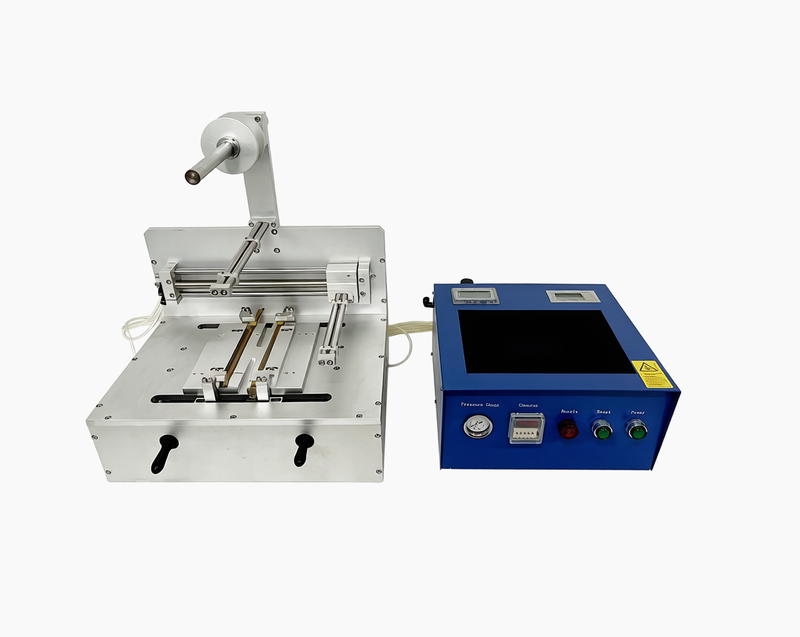
The Semi-Automatic Battery Electrode Stacking Machine MRX-BDP200-A is a compact laboratory and pilot-scale system developed for assembling lithium-ion battery electrodes through a controlled stacking process. It is designed to improve the consistency and productivity of electrode stacking compared with manual assembly, while maintaining a straightforward operating concept suitable for research and small-volume production.
The machine combines separator handling with reciprocating electrode placement to form a Z-fold stacking structure. During operation, the separator film is maintained under controlled tension while the pneumatic mechanism drives its lateral movement. This coordinated motion allows positive and negative electrode sheets to be positioned successively between separator layers to build the required cell structure.
With a benchtop configuration, the MRX-BDP200-A can be installed on a standard working table without requiring a large dedicated production area. The cantilever-style structure provides convenient access to the stacking area, making setup, adjustment, cleaning, and routine maintenance easier for laboratory operators.
The system accepts electrode dimensions from 20 to 200 mm in both length and width and can accommodate a separator roll with a maximum diameter of 250 mm. This relatively broad working range allows battery developers to evaluate different cell formats without changing to a completely different stacking platform.
A digital counter helps operators monitor stacking cycles during repeated experiments or small production batches, while the foot switch provides convenient control of the pneumatic movement. The overall design focuses on practical operation, repeatable stacking motion, and efficient prototype cell preparation rather than the complexity of a high-speed automated production line.
Key Specifications & Parameters
Model: MRX-BDP200-A.
Maximum Separator Roll Diameter: Φ250 mm.
Applicable Electrode Size: Length 20–200 mm and width 20–200 mm.
Power Supply: 220 V / 50 Hz.
Reciprocating Stroke: 300 mm.
Air Pressure: 0.5 MPa.
Machine Dimensions: 470 × 440 × 580 mm.
Control Box Dimensions: 360 × 400 × 200 mm.
Machine Weight: approximately 33 kg.
Stacking Method: Pneumatically assisted Z-fold stacking with controlled separator movement.
Operation: Foot-switch controlled pneumatic actuation with digital cycle counting.
Core Features
Benchtop Configuration: The compact structure allows the MRX-BDP200-A to be placed on a conventional laboratory or workstation surface, making it practical where floor space is limited.
Z-Fold Stacking Process: The separator moves alternately from side to side while electrode sheets are placed in sequence, creating a controlled Z-fold arrangement for lithium-ion battery cell assembly.
Controlled Separator Handling: A dedicated separator tension control system helps maintain stable film movement during stacking, reducing unwanted slack or excessive tension in the separator path.
Wide Electrode Size Range: The machine supports electrode lengths and widths from 20 to 200 mm, giving battery developers flexibility when preparing cells with different dimensions.
Pneumatic Actuation: The reciprocating mechanism is driven by a pneumatic cylinder, providing a simple and responsive method for controlling separator movement during the stacking cycle.
Foot-Switch Operation: A foot-operated control allows the operator to trigger the pneumatic action without continuously reaching for a manual control, which can make repetitive laboratory work more convenient.
Digital Cycle Counting: The integrated digital counter enables operators to keep track of stacking operations during experiments, prototype preparation, and small-batch trials.
Easy Setup and Adjustment: The mechanical structure is designed for relatively straightforward adjustment, operation, and maintenance, reducing the learning curve for laboratory personnel.
Accessible Cantilever Design: The cantilever-style arrangement provides an open working area around the stacking position, helping operators load materials and observe the assembly process.
Compact and Lightweight Structure: With a machine weight of approximately 33 kg, the system is considerably more suitable for laboratory environments and flexible workstation deployment than large industrial stacking platforms.
Main Functions
The primary function of the MRX-BDP200-A is to assemble positive and negative lithium-ion battery electrodes into a layered cell structure using a separator film. The machine coordinates separator movement and electrode placement to create a repeated Z-fold pattern.
Before operation, the separator roll is installed on the machine and the electrode dimensions are configured according to the intended cell design. During the stacking sequence, the separator is guided through controlled lateral movement while operators introduce the corresponding electrode sheets at the required positions.
The pneumatic system provides the mechanical movement required for the folding sequence, while the foot switch gives the operator direct control over the actuation cycle. This arrangement allows users to maintain hands-on control over the stacking process while benefiting from mechanically assisted movement.
The MRX-BDP200-A also functions as a practical prototype cell preparation platform. Its adjustable working range enables researchers to manufacture battery samples with different electrode dimensions for material evaluation, cell design optimization, process studies, and small-batch validation.
Specific Application Scenarios
Lithium-Ion Battery Research: The MRX-BDP200-A can be used in battery laboratories for preparing experimental cells after electrode fabrication and before subsequent cell assembly processes.
Pouch Cell Prototyping: Its Z-fold stacking configuration is suitable for development work involving layered electrode assemblies commonly used in pouch-type lithium-ion cells.
Battery Electrode Process Development: Researchers can use the machine to study the influence of electrode dimensions, stacking sequence, separator handling, and cell structure during prototype development.
Small-Batch Cell Production: The semi-automatic design provides a practical option for limited production quantities where a fully automated industrial stacking line would be unnecessary or uneconomical.
University and Research Laboratories: The benchtop structure and relatively simple operating method make the equipment suitable for academic laboratories conducting Battery Materials and cell fabrication research.
Battery Prototype Manufacturing: Cell developers can use the machine to prepare repeated prototype samples while maintaining a more consistent stacking motion than purely manual assembly.
New Cell Format Evaluation: The 20–200 mm electrode size range provides flexibility for evaluating different electrode dimensions during early-stage battery design and engineering verification.
FAQ
1. What is the MRX-BDP200-A used for?
The MRX-BDP200-A is a semi-automatic battery electrode stacking machine designed for Z-fold assembly of lithium-ion battery electrodes and separator film. It is primarily intended for battery research, prototype development, and small-batch production.
2. What type of stacking method does this machine use?
The machine uses a Z-fold stacking method. The separator moves alternately from side to side while positive and negative electrode sheets are placed sequentially to form the layered cell structure.
3. What electrode sizes can the MRX-BDP200-A handle?
The applicable electrode range is 20–200 mm in length and 20–200 mm in width, providing flexibility for different prototype cell dimensions.
4. What is the maximum separator roll diameter?
The machine can accommodate a separator roll with a maximum diameter of Φ250 mm.
5. Is the MRX-BDP200-A fully automatic?
No. It is a semi-automatic stacking system. The machine provides pneumatic assistance and controlled separator movement, while electrode placement and other operating actions remain under operator supervision.
6. How is the stacking mechanism controlled?
The pneumatic cylinder movement is operated using a foot switch, allowing the operator to control the stacking action conveniently during cell assembly.
7. Does the machine have a cycle counter?
Yes. A digital counter is provided to help users monitor the number of stacking operations performed during laboratory experiments or small production batches.
8. What air pressure is required?
The specified operating air pressure is 0.5 MPa.
9. Is this equipment suitable for laboratory use?
Yes. The benchtop design, compact dimensions, 33 kg weight, simple adjustment, and semi-automatic operating principle make the MRX-BDP200-A particularly suitable for battery R&D laboratories and prototype production environments.
10. What are the advantages compared with a manual stacking machine?
The MRX-BDP200-A provides mechanically assisted separator movement, more controlled stacking motion, higher operating efficiency, digital cycle counting, and greater consistency than a purely manual stacking process, while retaining operator flexibility.
11. Can the MRX-BDP200-A be used for different battery cell sizes?
Yes. Within its specified electrode working range of 20–200 mm in length and width, the machine can accommodate different electrode formats, making it useful for cell design evaluation and prototype development.



 Phone
Phone