Laboratory Vacuum Slurry Filtration Unit — MRX-GL-1
Product Introduction
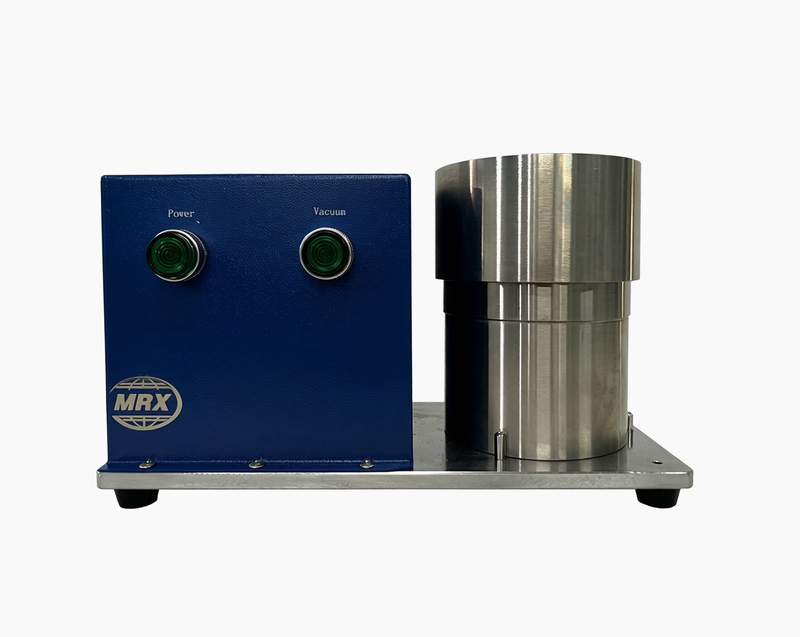
The Laboratory Vacuum Slurry Filtration Unit is a compact laboratory filtration system designed to improve the consistency and cleanliness of battery electrode slurry before subsequent coating processes. With a vacuum-assisted filtration method and interchangeable filter screens, the MRX-GL-1 provides researchers with a practical way to remove unwanted particles and control slurry cleanliness during small-batch material preparation.
In lithium-ion battery research, slurry quality directly influences the uniformity of electrode coating and the repeatability of laboratory experiments. The MRX-GL-1 is designed to support this preparation stage by applying vacuum suction across a relatively large filtration area. This configuration helps maintain efficient filtration while reducing pressure loss during processing.
The filtration unit is suitable for both cathode and anode slurry applications and can accommodate different filter mesh configurations according to material requirements. The standard configuration includes 80, 100 and 150 mesh filter screens, while alternative screens below 1000 mesh can be selected for applications requiring finer filtration.
Constructed from SUS304 stainless steel, the equipment is designed for laboratory environments where corrosion resistance, cleanliness and convenient maintenance are important. Its small footprint and approximately 4 kg overall weight make it easy to integrate into battery R&D laboratories, university research facilities and small-scale material development workflows.
Key Specifications & Parameters
The product model is MRX-GL-1. The system operates at AC 220 V ±10%, 50 Hz and uses vacuum-assisted filtration as its primary processing method. The vacuum level is rated at 65 kPa or higher, while the air pump flow rate is approximately 3 L/min.
The standard processing capacity is 500 ml, making the unit suitable for laboratory-scale slurry preparation and material evaluation. Standard filter screens include 80, 100 and 150 mesh configurations. Filter screens below 1000 mesh can also be selected according to the required filtration specification and material characteristics.
The recommended slurry viscosity is no greater than 20,000 cP, with a recommended solids content of no more than 80%. The filtration unit measures approximately 140 × 150 × 200 mm, while the vacuum generator measures approximately 140 × 70 × 150 mm. The total equipment weight is approximately 4 kg.
Core Features
The MRX-GL-1 uses vacuum-assisted filtration to improve the efficiency of small-batch slurry processing. Vacuum suction provides the driving force for filtration and allows the system to process laboratory slurry without relying solely on gravity filtration.
A large effective filtration area is incorporated into the filter assembly to help reduce pressure loss during operation. This design is beneficial when researchers need stable filtration performance while processing battery slurries with relatively high solids content.
The filtration configuration can be adapted through different mesh selections. Standard 80, 100 and 150 mesh screens provide practical options for common laboratory slurry preparation, while finer filter configurations can be selected when a more stringent particle filtration requirement is necessary.
SUS304 stainless steel construction provides a durable and easy-to-clean processing surface. The material is well suited to laboratory environments where resistance to corrosion and routine cleaning are important considerations.
The compact design minimizes the space required for filtration equipment. This allows the system to be positioned close to other laboratory battery processing equipment, creating a more efficient workflow from slurry mixing to filtration and electrode coating.
Main Functions
The primary function of the MRX-GL-1 is vacuum-assisted filtration of laboratory-scale slurry. It is designed to help remove unwanted particles and improve the physical consistency of the slurry before coating or further material processing.
For lithium-ion battery development, the system can be incorporated into the electrode slurry preparation process after mixing. Filtering the slurry before coating can help reduce the presence of oversized particles that may interfere with coating uniformity or downstream electrode processing.
The interchangeable filter configuration also allows researchers to investigate the influence of filtration mesh size on different formulations. This makes the unit useful not only for routine filtration but also for laboratory process optimization and comparative material studies.
The system can process both cathode and anode formulations, subject to the viscosity, solids content and chemical compatibility of the specific slurry. Its small capacity makes it particularly appropriate for experimental batches where material consumption needs to be controlled.
Specific Application Scenarios
In lithium-ion battery laboratories, the MRX-GL-1 can be positioned between slurry mixing and electrode coating. Researchers can use the unit to filter cathode or anode slurry before applying it to a laboratory coating system, helping establish a more controlled coating feedstock.
For battery material formulation research, the equipment can be used when evaluating different active material, conductive additive and binder combinations. The selectable filtration mesh allows researchers to investigate how filtration conditions affect the resulting slurry and coating behavior.
The unit is also suitable for university laboratories and research institutions conducting small-volume experiments. Its 500 ml capacity reduces material consumption while providing a dedicated filtration stage for experimental slurry preparation.
Beyond battery electrode slurry, the filtration unit can be considered for other laboratory formulations that fall within the recommended viscosity and solids-content range. Its compact structure makes it suitable for research involving fine-particle suspensions and specialized material formulations.
Frequently Asked Questions
1. What is the main purpose of the MRX-GL-1?
The MRX-GL-1 is designed for vacuum-assisted filtration of laboratory-scale slurry, particularly cathode and anode electrode slurry used in lithium-ion battery research.
2. What is the standard processing capacity?
The standard capacity is 500 ml, making the system suitable for small-batch laboratory experiments and battery material development.
3. What filter screens are included?
The standard configuration includes 80, 100 and 150 mesh filter screens. Other filter configurations below 1000 mesh can be selected according to specific application requirements.
4. Can the equipment filter both cathode and anode slurry?
Yes. The system is suitable for both cathode and anode slurry filtration, provided that the slurry falls within the recommended viscosity and solids-content range.
5. What slurry viscosity is recommended?
The recommended slurry viscosity is no greater than 20,000 cP. Actual filtration performance depends on the slurry formulation, particle characteristics and selected filter mesh.
6. What is the recommended maximum solids content?
The recommended solids content is no more than 80%. Material properties should be evaluated before selecting the appropriate filtration conditions.
7. What vacuum level can the system provide?
The specified vacuum level is 65 kPa or higher. The actual operating condition can vary depending on the material and filtration setup.
8. Why is slurry filtration important before electrode coating?
Filtration can help remove unwanted oversized particles and improve slurry cleanliness and consistency. This can contribute to more stable electrode coating when the filtration conditions are properly matched to the slurry formulation.
9. What material is used for the filtration equipment?
The main filtration unit is constructed from SUS304 stainless steel, providing good durability, corrosion resistance and convenient cleaning for laboratory use.



 Phone
Phone