Product Introduction
The Laboratory Battery Slurry Filtration Unit – MRX-GL-2 is designed for laboratory-scale filtration of battery electrode slurries before coating and subsequent material processing. With a 5-liter working capacity and vacuum-assisted filtration principle, the unit provides a practical solution for preparing cleaner and more uniform slurry batches during lithium battery research and development.
Built entirely from stainless steel, the MRX-GL-2 offers a durable working structure with good corrosion resistance and straightforward cleaning. Its filtration system can be configured with different mesh specifications according to slurry characteristics and process requirements, allowing researchers to adapt the equipment to different electrode material formulations.
The large effective filter area helps maintain low pressure loss during filtration, supporting stable slurry handling without requiring an unnecessarily large equipment footprint. By reducing coarse particles and unwanted agglomerates in the slurry, the system can contribute to improved material uniformity and more consistent electrode coating results.
With a compact structure, simple operating method, and dedicated vacuum filtration system, the MRX-GL-2 is well suited to battery laboratories, university research facilities, material development centers, and small-scale process development environments. It provides a convenient filtration step between slurry preparation and electrode coating experiments.
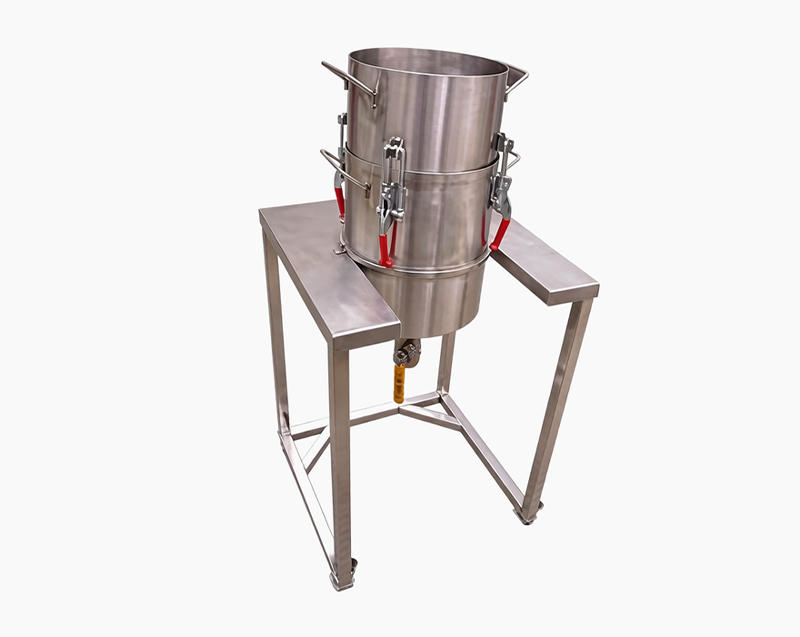
Key Specifications & Parameters
Product Model: MRX-GL-2
Power Supply: AC 220V ±10%, 50Hz
Working Capacity: 5 L
Filtration Method: Vacuum suction filtration
Vacuum Level: ≥65 kPa
Standard Filter Mesh: 80–120 mesh for lithium battery slurry applications
Optional Filter Mesh: Available with mesh specifications below 1000 mesh according to process requirements
Recommended Slurry Viscosity: ≤20,000 cP
Recommended Solid Content: ≤80%
Equipment Weight: Approximately 4 kg
Core Features
Full Stainless-Steel Construction: The main filtration structure uses stainless steel to provide good corrosion resistance, a clean working surface, and convenient maintenance for repeated laboratory use.
Vacuum-Assisted Filtration: The vacuum system creates the pressure difference required to move slurry through the selected filter screen, providing an efficient filtration process for laboratory battery material preparation.
5-Liter Filtration Capacity: Compared with smaller laboratory filtration units, the 5-liter capacity provides additional processing volume for slurry preparation, coating development, and repeated experimental batches.
Configurable Filter Mesh: Different mesh specifications can be selected according to the characteristics of the slurry and the required filtration conditions, with standard 80–120 mesh screens for lithium battery slurry applications.
Large Filtration Area: The relatively large effective filtration area helps reduce pressure loss during operation and supports smoother slurry flow through the filtration medium.
Compact Laboratory Design: Despite its 5-liter processing capacity, the unit maintains a practical structure for laboratory environments where operating space and equipment accessibility are important.
Easy Cleaning and Maintenance: The stainless-steel structure and straightforward filtration configuration make routine cleaning and maintenance more convenient after slurry processing.
Improved Slurry Uniformity: Filtration helps reduce unwanted particles and agglomerates in prepared slurry, supporting more consistent material distribution during subsequent electrode coating experiments.
Main Functions
Electrode Slurry Filtration: The MRX-GL-2 provides a dedicated filtration step for battery electrode slurry before coating, helping remove undesirable particles from prepared material.
Slurry Particle Conditioning: The filtration process helps control unwanted coarse particles and agglomerates, improving the overall condition of slurry used in laboratory coating experiments.
Vacuum Filtration Processing: The vacuum system assists slurry movement through the selected filter screen, providing a controlled method for laboratory filtration.
Pre-Coating Slurry Preparation: The unit can be positioned between slurry mixing and electrode coating to improve slurry quality before it enters the coating stage.
Small-Batch Battery Material Processing: With a 5-liter capacity, the equipment is suitable for laboratory batches used in formulation screening, process optimization, and electrode development.
Filtration of Different Electrode Slurries: Configurable mesh options allow researchers to adapt the filtration process to different battery slurry formulations and experimental requirements.
Specific Application Scenarios
Lithium-Ion Battery R&D Laboratories: The MRX-GL-2 can be used as a slurry filtration step during lithium-ion battery material research, particularly before laboratory electrode coating.
Cathode Slurry Preparation: Researchers can use the unit to filter cathode slurry after mixing and before coating, helping reduce unwanted particles and agglomerates in the prepared material.
Anode Slurry Preparation: The filtration system is also suitable for laboratory anode slurry processing where controlled particle removal is required before electrode fabrication.
Electrode Coating Process Development: The unit can support coating experiments by providing a controlled filtration stage between slurry preparation and coating, helping researchers investigate the relationship between slurry condition and coating consistency.
Battery Material Formulation Research: During the development of new electrode formulations, the MRX-GL-2 can be used to process small experimental batches and evaluate different filtration mesh configurations.
University and Research Institute Laboratories: Its compact structure and 5-liter capacity make the equipment suitable for academic laboratories conducting Battery Materials, electrode preparation, and energy storage research.
Battery Pilot Process Development: The MRX-GL-2 can serve as a laboratory-scale filtration unit during early-stage process development before filtration conditions are transferred to larger production systems.
FAQ
1. What is the MRX-GL-2 mainly used for?
The MRX-GL-2 is mainly used for vacuum-assisted filtration of battery electrode slurry in laboratory environments. It is typically applied between slurry preparation and electrode coating to help remove unwanted particles and agglomerates.
2. What is the working capacity of the MRX-GL-2?
The unit has a nominal working capacity of 5 liters, making it suitable for larger laboratory slurry batches and battery electrode development experiments compared with small-volume filtration equipment.
3. What filter mesh is supplied as standard?
The standard configuration is designed for lithium battery slurry applications using 80–120 mesh filter screens. Different mesh specifications can be selected according to the slurry and filtration requirements.
4. Can the filter mesh be customized?
Yes. The MRX-GL-2 supports optional filter mesh specifications below 1000 mesh, allowing the filtration configuration to be adjusted for different laboratory process requirements.
5. What type of filtration does this equipment use?
The MRX-GL-2 uses vacuum suction filtration. The vacuum system generates the required suction force to draw slurry through the selected filter screen.
6. What slurry viscosity is recommended for the MRX-GL-2?
The recommended slurry viscosity is no more than 20,000 cP, with a recommended solid content of no more than 80%. Actual filtration performance can vary depending on slurry formulation and filter mesh selection.
7. Can the MRX-GL-2 be used for both cathode and anode slurry?
Yes. The unit can be applied to laboratory cathode and anode slurry filtration, provided that the slurry characteristics are within the recommended operating range and the appropriate filter mesh is selected.
8. Why is a large filtration area important?
A larger effective filtration area can help distribute slurry flow across the filter medium and reduce pressure loss during filtration. This supports smoother operation and helps maintain practical filtration efficiency.
9. Is the MRX-GL-2 easy to clean?
Yes. The stainless-steel construction provides a cleanable working surface, while the relatively simple filtration structure makes routine cleaning and maintenance convenient for repeated laboratory experiments.
10. Where can the MRX-GL-2 be used?
The unit is suitable for lithium battery laboratories, university research centers, battery material development facilities, electrode coating laboratories, and small-scale battery process development applications.



 Phone
Phone