Electric Vertical Roll-to-Roll Calendering Machine MRX-DG100L
Product Introduction
The MRX-DG100L Electric Vertical Calendering Machine is a laboratory-scale roll press developed for controlled processing of battery electrodes and other sheet-form energy materials. It provides a practical way to refine electrode thickness and compaction after coating and drying, helping researchers evaluate how mechanical compression influences electrode structure and material density.
Driven by an electric gear transmission system, the MRX-DG100L provides powered roller movement for repeatable laboratory processing. The forward and reverse operating modes give users additional flexibility when positioning samples or conducting different rolling procedures.
The roller gap can be adjusted from 0 to 2 mm, enabling researchers to establish different compression conditions according to the initial electrode thickness and desired processing result. Combined with adjustable feed speed, this configuration allows systematic investigation of electrode calendering parameters during battery development.
The machine is equipped with hardened rollers featuring a hard-chrome surface treatment. With a roller hardness of HRC62 and cylindricity controlled within ±2 μm, the rolling system is designed to provide stable and precise contact conditions across the working area.
Its vertical structure creates a convenient feeding path for sheet and strip materials while maintaining a compact laboratory footprint. The standard working width is up to 100 mm, with wider 150, 200, 250, and 300 mm configurations available for different experimental requirements.
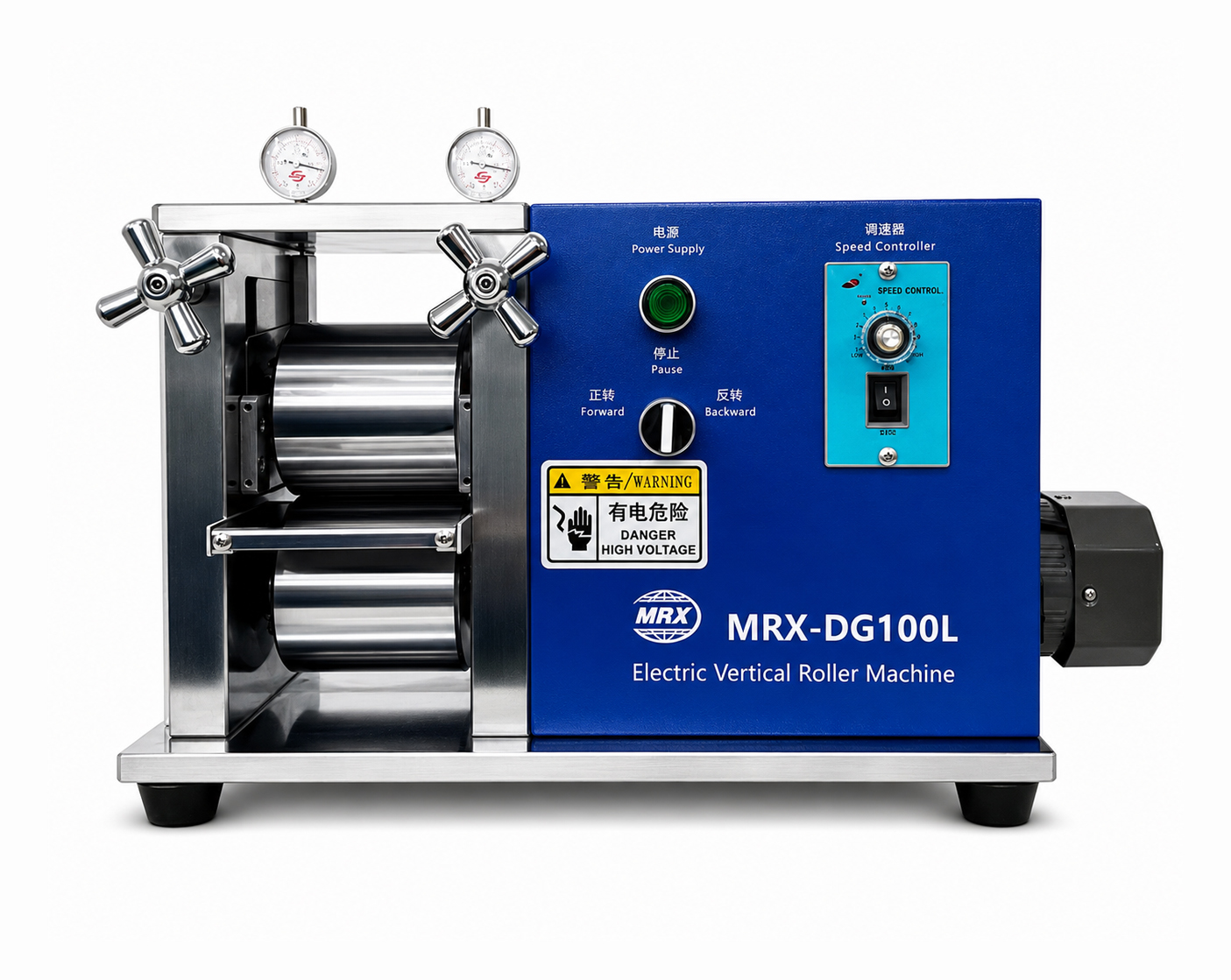
Key Specifications & Parameters
Model: MRX-DG100L
Roller Diameter: 96 mm
Roller Hardness: HRC62
Roller Surface Finish: 0.4 or better
Adjustable Roll Gap: 0–2 mm
Standard Rolling Width: 0–100 mm
Optional Rolling Widths: 150, 200, 250, or 300 mm
Maximum Roller Pressure: 4 tons
Roller Cylindricity: ≤ ±2 μm
Feed Speed: 0–40 mm/s
Power Supply: AC 220 V / 50 Hz
Rated Power: 120 W
Overall Dimensions: 480 × 220 × 280 mm
Equipment Weight: 50 kg
Core Features
Hardened and Chrome-Plated Rollers
The rollers are hardened to HRC62 and finished with a hard-chrome surface treatment. This provides a durable working surface with good resistance to wear and corrosion during repeated laboratory processing.
High Roller Precision
Roller cylindricity is controlled within ±2 μm, helping maintain consistent roller contact and support stable processing conditions across the working width.
Self-Locking Gap Adjustment
A wedge-block adjustment mechanism is used to set the roller clearance. Its self-locking design helps maintain the selected position while providing fine control over the working gap.
Vertical Material Feeding
The vertical roller arrangement provides a convenient feeding direction for electrode sheets and strip materials, making sample handling more practical during laboratory experiments.
Electric Gear Transmission
The roller system is powered by gear transmission, eliminating the need for manual rolling and providing a more controlled approach to laboratory electrode processing.
Adjustable Rolling Speed
The feed speed can be adjusted from 0 to 40 mm/s, allowing users to compare different rolling conditions when optimizing electrode processing parameters.
Forward and Reverse Operation
Both forward and reverse roller movement are supported, providing greater operational flexibility when feeding, repositioning, or processing laboratory samples.
Main Functions
Electrode Thickness Reduction
The MRX-DG100L compresses coated electrode material between two rollers to reduce its overall thickness. Researchers can adjust the working gap according to the starting thickness and target processing condition.
Electrode Densification
Controlled compression increases the compactness of the electrode coating. This allows researchers to study the relationship between calendering conditions, electrode density, thickness, and subsequent cell performance.
Battery Electrode Process Development
The machine provides a controllable calendering stage within a laboratory battery manufacturing workflow, typically positioned after electrode coating and drying and before electrode cutting and cell assembly.
Sheet and Strip Material Processing
Its vertical structure allows suitable sheet and strip materials to be introduced between the rollers for controlled compression within the specified working width and thickness range.
Calendering Parameter Evaluation
Adjustable roller clearance and feed speed enable researchers to compare different processing conditions and identify suitable calendering parameters for specific electrode formulations.
Specific Application Scenarios
Lithium-Ion Battery Electrode Research
The MRX-DG100L can be incorporated into laboratory lithium-ion battery workflows after electrode coating and drying. It provides controlled compression for both suitable cathode and anode electrode samples before further processing.
Electrode Density Optimization
Researchers can vary the roll gap and feed speed to investigate how different compression levels influence electrode density and thickness during material development.
New Battery Material Development
When evaluating new active materials and electrode formulations, controlled calendering provides a repeatable mechanical processing step for comparing different electrode structures.
Clean Energy Material Research
The machine can be used for laboratory research involving suitable clean energy materials and sheet-form materials that require controlled two-roll compression.
University and Research Institute Laboratories
Its laboratory-scale configuration makes the MRX-DG100L suitable for universities, research institutes, battery technology laboratories, and materials research centers conducting small-batch electrode experiments.
Battery Pilot Process Development
During early-stage pilot development, the machine can help researchers evaluate electrode calendering parameters before transferring the optimized process to larger-scale battery production equipment.
Frequently Asked Questions
1. What is the MRX-DG100L used for?
The MRX-DG100L is an electric laboratory roll press designed primarily for reducing the thickness and increasing the density of battery electrode materials. It can also be used for suitable clean energy material research.
2. What is battery electrode calendering?
Battery electrode calendering is a compression process in which a coated and dried electrode passes between two rollers. The controlled pressure reduces electrode thickness and increases the compactness of the electrode coating.
3. Can the MRX-DG100L process lithium-ion battery electrodes?
Yes. The machine is designed for laboratory battery material processing and can be used for suitable lithium-ion battery cathode and anode electrode samples.
4. What is the adjustable roller gap?
The roller gap can be adjusted from 0 to 2 mm, allowing researchers to establish different compression conditions according to the electrode thickness and experimental requirements.
5. What is the maximum rolling pressure?
The maximum specified roller pressure is 4 tons, providing substantial compression capability for laboratory-scale electrode calendering.
6. What rolling widths are available?
The standard configuration supports a rolling width of up to 100 mm. Optional widths of 150, 200, 250, and 300 mm are available for different laboratory processing requirements.
7. What is the roller hardness?
The rollers have a hardness of HRC62 and feature a hard-chrome surface treatment, providing a durable working surface for repeated laboratory rolling operations.
8. Can the rolling speed be adjusted?
Yes. The feed speed can be adjusted from 0 to 40 mm/s, enabling researchers to evaluate different rolling speeds during electrode process development.
9. Does the MRX-DG100L support reverse operation?
Yes. The electric drive supports both forward and reverse operation, providing additional flexibility when positioning or processing laboratory samples.
10. Is this machine suitable for university battery laboratories?
Yes. The adjustable processing parameters, precision rollers, electric drive, and compact laboratory-oriented configuration make the MRX-DG100L suitable for universities, research institutes, and battery R&D laboratories.



 Phone
Phone