Product Introduction
The MRX-XJB-7 2L planetary vacuum mixer is designed for laboratory battery slurry preparation, electrode material development, formulation testing, and small-batch research applications. It integrates planetary mixing, high-speed dispersion, vacuum deaeration, wall scraping, temperature monitoring, and jacket-assisted heating or cooling into one processing system. The equipment is suitable for both dry mixing and wet mixing processes and is particularly useful for preparing lithium-ion battery cathode and anode slurry before coating.
The mixing system combines low-speed planetary movement with high-speed dispersion. During operation, the mixing mechanism revolves around the vessel while the mixing shaft rotates simultaneously, creating continuous material circulation throughout the mixing chamber. The high-speed dispersing disc provides additional shear force to break down agglomerates and improve the distribution of powders, binders, solvents, conductive additives, and active materials. This combined mixing principle helps achieve consistent material dispersion while reducing poorly mixed areas inside the vessel.
The effective mixing capacity of the standard configuration is 2 L. The mixing vessel and main material-contact components are manufactured from SUS304 stainless steel. The inner surface of the vessel is precision machined and polished to provide good roundness, a smooth contact surface, and easier cleaning between different experimental batches. A 5 L configuration and other vessel sizes may also be supplied according to specific process requirements.
Vacuum mixing is one of the key functions of the MRX-XJB-7. The mixing and dispersing processes can be carried out in a sealed vessel under vacuum, helping remove entrapped air introduced during powder wetting, kneading, and high-speed dispersion. Reducing bubbles in electrode slurry is beneficial for subsequent laboratory coating and electrode preparation processes where material consistency and surface quality need to be carefully controlled.
The machine is equipped with independently adjustable mixing and dispersing speeds. Planetary revolution can be adjusted from 0 to 50 rpm, while the mixing shaft provides an adjustable speed range of 0 to 80 rpm relative to the planetary gearbox, or approximately 0 to 130 rpm relative to the machine base reference. The high-speed dispersing shaft operates from 0 to 6000 rpm. These adjustable parameters allow researchers and process engineers to establish different mixing stages according to slurry viscosity, solids content, material characteristics, and formulation requirements.
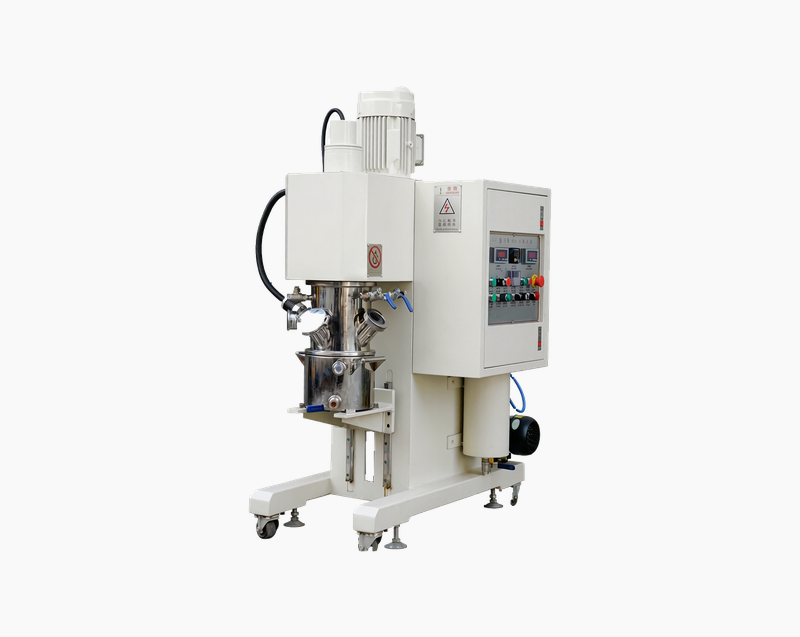
Key Specifications & Parameters
Model: MRX-XJB-7.
Equipment Type: Planetary dispersing vacuum mixer.
Effective Capacity: 2 L standard working volume. A 5 L configuration and other specifications can be supplied according to application requirements.
Mixing Vessel Size: Approximately Ø240 mm × 180 mm.
Vessel Material: SUS304 stainless steel with precision-machined and polished inner surfaces.
Planetary Revolution Speed: 0–50 rpm, adjustable.
Mixing Shaft Speed: 0–80 rpm relative to the planetary gearbox, or approximately 0–130 rpm relative to the ground reference.
Mixing Blade Type: SUS304 spiral twisted-frame mixing blade.
High-Speed Dispersion Speed: 0–6000 rpm, adjustable by variable-frequency control.
Maximum Dispersing Linear Speed: Approximately 17 m/s.
Dispersing Disc Diameter: Ø55 mm.
Planetary Mixing Motor: 1.5 kW, 4-pole motor with matched variable-frequency drive.
Dispersion Motor: 2.2 kW, 2-pole motor with matched variable-frequency drive.
Hydraulic Lifting Motor: 0.37 kW, 4-pole motor.
Wall Scraper: One set, manufactured from SUS304 stainless steel and Teflon, operating together with the planetary revolution mechanism.
Reference Blade-to-Bottom Clearance: Approximately 2–4 mm.
Reference Blade-to-Wall Clearance: Approximately 3 ± 1.5 mm.
Vacuum Level: Up to approximately ≤ -0.098 MPa under specified operating conditions.
Vacuum Pump: 2XZ-2 vacuum pump with vacuum buffer tank and control valve.
Vacuum Sealing: Mechanical dynamic sealing combined with O-ring static sealing.
Temperature Measurement: 0–300°C temperature measurement range with a material-contact probe positioned close to the lower section of the mixing vessel.
Jacket System: Double-layer jacketed vessel supporting circulation of cooling or heated water.
Jacket Connections: G3/8" inlet and outlet connections with quick-connect fittings.
Bottom Discharge: G1/2" ball valve.
Hydraulic Lifting Travel: Up to approximately 270 mm.
Electrical Supply: 380 V / 50 Hz / 3 Phase.
Control Voltage: 220 V converted to 24 V for applicable control circuits.
Main Equipment Power: Approximately 3.7 kW plus 0.37 kW hydraulic lifting motor.
Machine Dimensions: Approximately 1200 × 700 × 1800 mm.
Machine Weight: Approximately 400 kg.
Timing Function: Adjustable process timing from 0 to 99 hours on applicable configurations, with automatic stopping after the preset operating period.
Core Features
Integrated Planetary Mixing and High-Speed Dispersion: The system combines bulk material circulation with high-shear dispersion. Planetary movement supports continuous movement of material through different areas of the vessel, while the dispersing disc provides localized shear for particle deagglomeration and fine dispersion.
Vacuum Deaeration During Mixing: The sealed vessel allows battery slurry to be mixed under vacuum. Air introduced during the mixing process can be removed before downstream coating, helping reduce bubbles and improve slurry processing consistency.
Adjustable Mixing Parameters: Planetary revolution, low-speed mixing, and high-speed dispersion can be adjusted according to different material properties. This flexibility makes the machine suitable for formulation development where multiple mixing stages or different shear conditions need to be evaluated.
Reduced Mixing Dead Zones: The combination of planetary movement, spiral mixing structure, dispersing disc, and wall scraper promotes material movement around the vessel wall and bottom, reducing areas where slurry may remain insufficiently mixed.
Jacketed Temperature Management: Cooling or heated water can circulate through the outer jacket of the mixing vessel. This allows operators to manage process temperature during viscosity-sensitive or temperature-sensitive material preparation.
SUS304 Stainless Steel Construction: The mixing vessel and principal material-contact components use SUS304 stainless steel, providing corrosion resistance for many commonly used battery slurry materials and facilitating cleaning between laboratory batches.
Hydraulic Vessel Lifting: A hydraulic lifting structure with dual guide rods and positioning components allows the vessel to move vertically for loading, unloading, cleaning, inspection, and positioning.
Material Feeding and Process Observation: The upper vessel cover is equipped with a powder or liquid feeding port, illumination, observation window, vacuum gauge, vacuum interface, vent connection, and additional process connections.
Vacuum Backflow Protection: The vacuum system includes a buffer tank designed to reduce the risk of vacuum pump oil returning toward the mixing vessel.
Operational Safety Design: Electrical and mechanical interlocks help prevent mixing or dispersion from starting while the vessel is being lifted. Vessel lowering is restricted during operation and under vacuum, while positioning and locking components help keep the vessel securely aligned with the upper cover.
Optional HMI Control: The standard configuration supports manual operation of vacuum, speed adjustment, temperature display or control, lighting, lifting, and emergency stop functions. An HMI control system can be provided as an optional configuration when required.
Main Functions
Electrode Slurry Preparation: The machine can mix active materials, conductive additives, binders, solvents, and other formulation components used in battery cathode and anode slurry development.
Powder Wetting and Homogenization: Planetary motion promotes repeated folding, kneading, and circulation of powder and liquid components, supporting more uniform wetting during the early stages of slurry preparation.
High-Shear Dispersion: The high-speed dispersing disc applies shear force to agglomerated particles and assists with uniform distribution of solid components throughout the slurry.
Vacuum Bubble Removal: Vacuum operation removes entrapped air generated during mixing and dispersion, preparing the slurry for subsequent coating and electrode processing.
Dry and Wet Mixing: The equipment supports both dry premixing and wet slurry processing, allowing researchers to establish different material addition sequences according to their experimental procedure.
Controlled Heating and Cooling: The jacketed vessel can use circulating cooling or heated water to assist with temperature management during slurry preparation.
Multi-Stage Process Development: Adjustable speed and timing allow users to establish different processing stages for wetting, kneading, dispersion, homogenization, and vacuum deaeration according to the selected control configuration.
Specific Application Scenarios
Lithium-Ion Battery Electrode R&D: The MRX-XJB-7 can be used to prepare cathode and anode slurry before coating during lithium-ion battery electrode development. Researchers can adjust mixing and dispersion parameters when evaluating new formulations, material ratios, binders, conductive agents, or process conditions.
Coin Cell Material Research: In coin cell laboratories, the planetary vacuum mixer can be used at the beginning of the electrode preparation process before coating, drying, roll pressing, electrode punching, and coin cell assembly. It is suitable for universities, research institutions, and battery material laboratories that require controlled preparation of experimental electrode slurry.
Pouch Cell Laboratory Development: The equipment can form part of a laboratory pouch cell production process together with coating machines, Vacuum Drying Ovens, roll presses, electrode cutting equipment, stacking machines, electrolyte filling equipment, and Pouch Cell Sealing systems.
Cylindrical Battery Research: The machine can be used for electrode slurry preparation during laboratory-scale cylindrical cell development before electrode coating and subsequent cell assembly processes.
Battery Material Development: Battery material manufacturers and research laboratories can use the mixer when evaluating active materials, binders, conductive additives, solvents, and other electrode formulation components.
University and Research Institute Laboratories: The 2 L effective working capacity makes the system suitable for research environments requiring greater processing capability than small desktop mixers while remaining appropriate for laboratory-scale formulation studies.
Battery Pilot Process Evaluation: The MRX-XJB-7 can also support small-batch process verification before material formulations are transferred to larger pilot or production-scale mixing equipment.
FAQ
1. What is the MRX-XJB-7 2L Planetary Vacuum Mixer used for?
The machine is primarily used for laboratory battery slurry preparation, electrode material mixing, high-speed dispersion, vacuum deaeration, and formulation development. It is suitable for battery R&D laboratories, material research centers, universities, and small pilot-scale processes.
2. Can this planetary vacuum mixer be used for lithium-ion battery cathode and anode slurry?
Yes. The equipment can be used to prepare both cathode and anode electrode slurry, depending on the formulation and material compatibility. Active materials, conductive additives, binders, solvents, and other components can be mixed and dispersed under controlled conditions.
3. What is the working capacity of the MRX-XJB-7?
The standard model described here has an effective working capacity of 2 L. A 5 L configuration and other vessel specifications may also be available according to the required batch size and application.
4. Can the slurry be mixed under vacuum?
Yes. Mixing and dispersion can be performed under vacuum, with a specified vacuum level of up to approximately ≤ -0.098 MPa under suitable operating conditions. Vacuum mixing helps remove trapped air and bubbles generated during slurry preparation.
5. Why does the machine use both planetary mixing and high-speed dispersion?
Planetary mixing is used to circulate, fold, and knead the bulk material, while the high-speed dispersing disc generates stronger shear forces for particle deagglomeration and fine dispersion. Using both mechanisms provides greater flexibility when processing multi-component battery slurry.
6. Is the mixing speed adjustable?
Yes. The planetary revolution speed is adjustable from 0 to 50 rpm, while the high-speed dispersing shaft operates from 0 to 6000 rpm. Adjustable speeds allow different processing conditions to be established for materials with different viscosities and formulation requirements.
7. Can the mixing vessel be heated or cooled?
Yes. The vessel has a jacket that can circulate cooling water or heated water. The machine also includes material temperature measurement, allowing operators to observe temperature changes during the mixing process.
8. What material is used for the mixing vessel?
The mixing vessel and main product-contact components are manufactured from SUS304 stainless steel. The wall scraper uses SUS304 and Teflon components. Compatibility with specific chemicals and solvents should be confirmed according to the actual formulation.
9. Can the MRX-XJB-7 be used as part of a complete battery laboratory line?
Yes. It can be used as the slurry preparation stage of an electrode manufacturing process and combined with laboratory coating machines, drying ovens, roll presses, electrode cutters, punching machines, cell assembly equipment, electrolyte filling systems, sealing machines, and glove boxes.
10. Is a touch-screen or PLC control system available?
The standard configuration can use manual operation controls for vacuum, variable-frequency speed adjustment, temperature display or control, lighting, hydraulic lifting, and emergency stop. An HMI-based control configuration can be supplied as an optional solution according to project requirements.
11. Is this machine suitable for high-viscosity materials?
The planetary mixing and dispersing structure is suitable for many slurry formulations that require strong circulation and shear. Actual processing capability depends on viscosity, solids content, material composition, batch volume, and required operating parameters, so these details should be confirmed before equipment selection.
12. What information is required before selecting the correct mixer configuration?
Recommended information includes material type, target batch volume, approximate viscosity, solids content, solvent system, desired vacuum level, mixing and dispersion requirements, temperature conditions, electrical supply, and preferred control method. This information helps determine a suitable equipment configuration for the intended battery R&D process.



 Phone
Phone