Vacuum Standing Chamber for Battery Electrolyte Wetting MRX-JZX-300
The MRX-JZX-300 Vacuum Standing Chamber for Lithium Battery Electrolyte Wetting is developed for the post-filling treatment of pouch and cylindrical battery cells. After electrolyte injection, the controlled vacuum environment helps facilitate contact between the electrolyte and the internal electrode assembly, supporting a more thorough wetting process before subsequent battery manufacturing steps.
Rather than functioning as a simple vacuum enclosure, the MRX-JZX-300 provides a controlled standing process with adjustable holding time and multi-stage cycling. This configuration gives battery engineers greater flexibility when developing electrolyte wetting procedures for different cell formats, electrolyte quantities, and internal electrode structures.
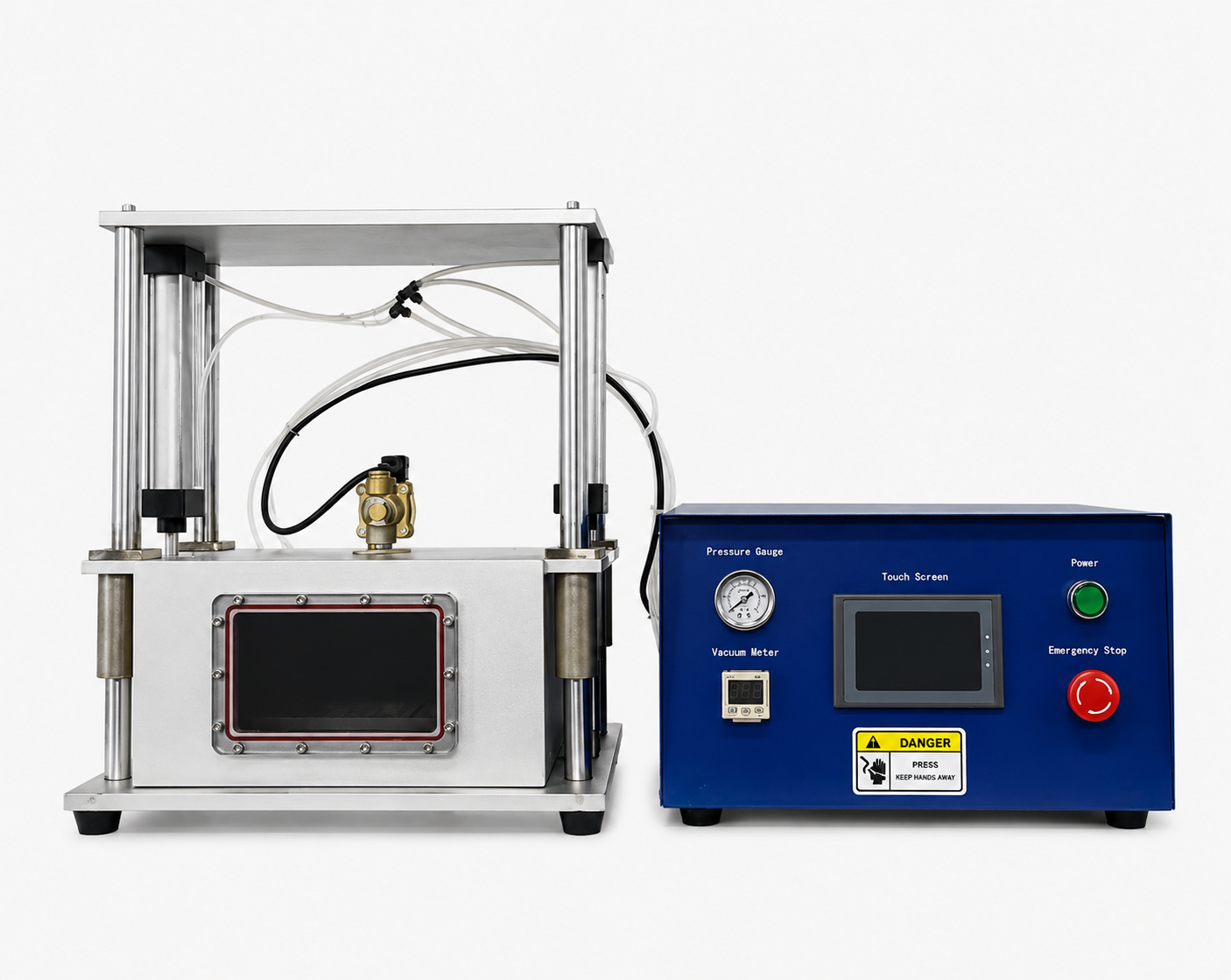
The chamber and control unit use a separated configuration, allowing the main working chamber to be positioned inside an argon glove box when required, while the control section remains outside the glove box. The same configuration can also be integrated into a battery production line, providing flexibility for both laboratory and manufacturing environments.
Key Specifications & Parameters
The MRX-JZX-300 provides an adjustable standing period from 0 to 99.99 seconds. This programmable time range allows operators to establish different vacuum holding conditions during electrolyte wetting experiments and production processes.
The chamber can achieve a vacuum level of up to -95 kPa. Stable vacuum maintenance is designed to minimize significant pressure fluctuation during the holding stage, helping create a more controlled environment for electrolyte wetting.
The working chamber has an internal volume of approximately 330 × 200 × 150 mm. The chamber is constructed from aluminum alloy to provide a combination of structural strength, corrosion resistance, and suitability for battery laboratory environments.
The equipment operates with a 220V / 50Hz power supply. The supplied specifications indicate a 50W power rating for one configuration and 100W for the equipment power section. The required compressed-air supply is 0.5–0.7 MPa.
The approximate dimensions of the operating chamber section are 470 × 300 × 550 mm, while the control section measures approximately 460 × 560 × 250 mm. The complete equipment weighs approximately 46 kg.
Core Features
The MRX-JZX-300 is designed to accommodate different battery sizes and formats through a straightforward internal adjustment arrangement. This allows users to configure the working area according to the cells being processed without significantly complicating daily operation.
Its split chamber-and-control architecture provides greater installation flexibility. The working chamber can be placed inside an inert-atmosphere glove box for moisture-sensitive battery assembly processes, while the control system can remain outside. It can also be arranged as part of a conventional battery production workstation or pilot line.
The vacuum system is designed to maintain a relatively stable negative pressure during the standing cycle. Consistent pressure conditions are important when engineers are establishing repeatable electrolyte wetting procedures for battery cells.
A multi-stage cycling function enables users to perform repeated vacuum and standing operations according to the selected process sequence. This provides additional process flexibility compared with a single fixed vacuum-holding operation.
A transparent observation window allows operators to monitor the interior of the chamber during operation. This makes it easier to observe cell behavior and process conditions without opening the chamber and interrupting the vacuum cycle.
The upper chamber mechanism is driven pneumatically and guided by two linear guide sleeves. This arrangement supports controlled vertical movement and accurate positioning of the chamber, helping maintain the sealing conditions required for vacuum operation.
The compact equipment structure, relatively low operating complexity, and separated control configuration make the MRX-JZX-300 suitable for laboratories and production areas where installation space and process accessibility are important.
Main Functions
The primary function of the MRX-JZX-300 is to provide a controlled vacuum environment for battery cells following electrolyte filling. The reduced pressure condition can assist the electrolyte in contacting and penetrating the internal electrode assembly more effectively during the standing process.
The equipment provides adjustable vacuum standing time so that battery engineers can establish suitable process conditions for different cell designs. This is particularly useful during laboratory development, where wetting parameters may need to be changed repeatedly during process optimization.
The multi-cycle operating function allows vacuum treatment and standing stages to be repeated according to the selected process requirements. Repeated pressure cycles can be evaluated during battery process development to determine an appropriate electrolyte wetting procedure.
The chamber can process both pouch and cylindrical battery cells within its available working dimensions. Its flexible configuration makes it useful for different battery development programs rather than being limited to a single cell format.
Specific Application Scenarios
The MRX-JZX-300 is designed for lithium-ion battery cell assembly after electrolyte injection. In a typical pouch cell development process, cells can be placed inside the chamber after filling so that vacuum treatment and standing can be performed before subsequent sealing or cell conditioning operations.
For cylindrical battery development, the equipment can be used to support electrolyte wetting procedures for appropriately sized cylindrical cells. Engineers can adjust the standing conditions according to the cell structure and electrolyte filling process being evaluated.
In battery research laboratories, the vacuum chamber can be used to investigate electrolyte wetting behavior and optimize process parameters. Adjustable standing time and multi-stage cycling provide researchers with greater flexibility when comparing different experimental procedures.
The separated chamber and control configuration makes the equipment suitable for glove box-based battery research. The working chamber can be positioned within an argon atmosphere when the cell assembly process requires controlled environmental conditions.
For pilot production and small-scale manufacturing, the MRX-JZX-300 can serve as a dedicated vacuum electrolyte wetting station. Its compact dimensions allow it to be incorporated into development lines and production workstations without requiring the space associated with large industrial vacuum systems.
The equipment is also useful during new battery process qualification. Engineers can use it to establish vacuum level, holding time, and cycle parameters before transferring a validated electrolyte wetting process to higher-throughput production equipment.
Frequently Asked Questions
1. What is the MRX-JZX-300 used for?
The MRX-JZX-300 is used for vacuum standing and electrolyte wetting of battery cells after electrolyte injection. It is primarily intended for pouch and cylindrical lithium-ion battery development and production processes.
2. How does vacuum treatment assist electrolyte wetting?
A reduced-pressure environment can help improve contact between the electrolyte and internal electrode structures after filling. The actual wetting effect depends on the cell design, electrolyte formulation, filling quantity, materials, and selected process parameters.
3. Can the MRX-JZX-300 process pouch and cylindrical cells?
Yes. The chamber can be configured for different battery formats within its available working dimensions, including pouch cells and appropriately sized cylindrical cells.
4. What vacuum level can the chamber reach?
The specified maximum vacuum level is approximately -95 kPa. Actual operating conditions can be selected according to the battery process and material requirements.
5. Can the standing time be adjusted?
Yes. The standing time can be set within a range of 0–99.99 seconds, providing flexibility for different experimental and production process requirements.
6. Does the equipment support multiple vacuum cycles?
Yes. The MRX-JZX-300 includes multi-stage cycle functionality, allowing users to establish repeated vacuum and standing sequences when developing or implementing electrolyte wetting processes.
7. Can the chamber be installed inside a glove box?
Yes. The split design allows the working chamber to be positioned inside an argon glove box while the control unit is located outside, provided that the glove box dimensions and installation conditions are suitable.
8. Can operators observe the cells during vacuum treatment?
Yes. A transparent observation window allows operators to monitor changes inside the chamber during the operating cycle without opening the chamber.
9. What type of material is used for the vacuum chamber?
The chamber is constructed from aluminum alloy, providing a combination of corrosion resistance, structural strength, and suitability for battery development environments.
10. Is the MRX-JZX-300 suitable for battery R&D?
Yes. The adjustable standing time, multi-cycle capability, stable vacuum operation, and glove box compatibility make it suitable for electrolyte wetting research, cell prototype development, and battery process optimization.
MRX-JZX-300 for Battery Electrolyte Wetting Development
Effective electrolyte wetting is an important stage in lithium-ion battery cell manufacturing because the electrolyte must establish sufficient contact with the internal electrode structure before subsequent cell conditioning and testing. The MRX-JZX-300 provides battery engineers with a dedicated vacuum environment for developing and implementing this stage in a controlled manner.
With stable vacuum operation, adjustable standing time, multi-stage cycling, transparent observation, and a split chamber-and-control configuration, the MRX-JZX-300 can adapt to laboratory research as well as pilot-scale battery production. Manufactured by Shenzhen Mingrui Xiang Automation Equipment Co., Ltd., it provides a compact solution for controlled vacuum electrolyte wetting of pouch and cylindrical battery cells.



 Phone
Phone