Product Introduction
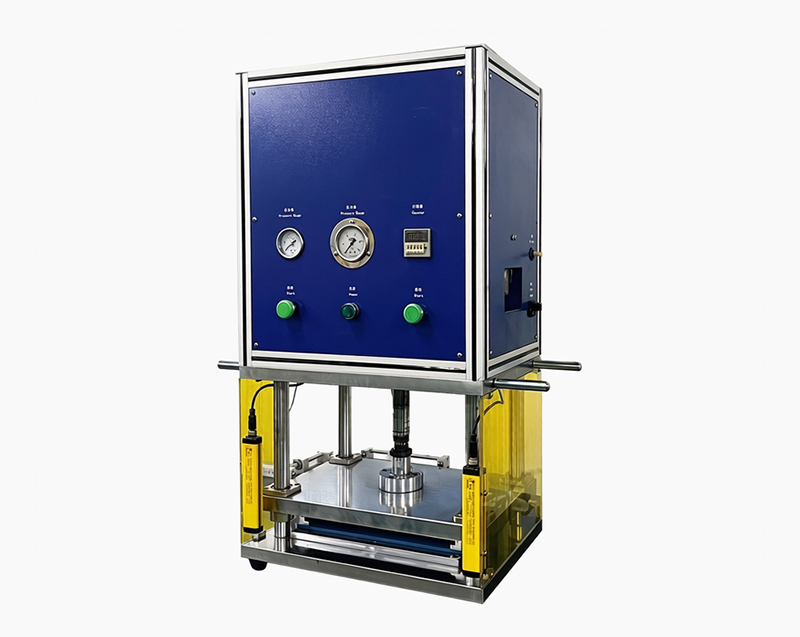
The Semi-Automatic Battery Electrode Die Cutting Machine MRX-MQ280 is designed for controlled forming and die cutting of positive and negative electrode sheets used in lithium-ion stacked battery development and production. Instead of relying on a conventional mechanical cutting process, the machine applies controlled pressure through a pneumatic-hydraulic intensifier to achieve repeatable electrode forming with interchangeable cutting dies.
The MRX-MQ280 accommodates both individual electrode sheets and roll-fed electrode materials, giving battery researchers and pilot-line operators greater flexibility when working with different electrode formats. Its maximum cutting area reaches 280 × 180 mm, while customized die geometries can be produced according to the required cell design. This makes the system suitable for experimental battery development as well as small-batch electrode preparation.
A precision upper and lower platen structure works together with a dedicated cutting tool to maintain dimensional consistency during the cutting cycle. The machine is also designed to minimize visible defects such as excessive burrs, powder shedding, and compression marks, helping users prepare cleaner electrode components for subsequent stacking and cell assembly processes.
For positioning accuracy, the MRX-MQ280 incorporates an infrared alignment system that helps operators locate electrode material before cutting. The cutting cycle can be counted automatically, while a safety light curtain interlock provides additional protection during machine operation. Its compact sheet-metal enclosure, straightforward controls, and accessible die-changing structure make the equipment practical for battery laboratories, pilot production areas, and electrode preparation workstations.
Key Specifications & Parameters
Model: MRX-MQ280
Power Supply: 220 V / 50 Hz.
Rated Power: 100 W.
Compressed Air: 0.5–0.8 MPa.
Maximum Cutting Size: 280 × 180 mm, with customized dimensions available according to application requirements.
Cutting Accuracy: ±0.1 mm.
Pressure Cylinder: 3 tons.
Machine Dimensions: 600 × 390 × 940 mm.
Machine Weight: approximately 180 kg.
Vertical Burr: ≤15 μm.
Horizontal Burr: ≤20 μm.
Material Feeding: Supports both sheet-type and roll-type electrode material feeding.
Die Configuration: Standard positive and negative electrode dies are available, while customized die shapes can be manufactured according to the required electrode geometry.
Core Features
Flexible Sheet and Roll Material Handling: The MRX-MQ280 can accommodate either pre-cut electrode sheets or roll-fed material, allowing the same platform to support different laboratory and pilot-line workflows.
Adjustable Cutting Performance: Its pneumatic-hydraulic intensifier provides controlled cutting pressure, while the cutting speed can be adjusted to match different electrode materials and die configurations.
Precision Die Cutting Structure: The coordinated upper and lower precision platens provide stable support during the cutting process, helping maintain the designed electrode dimensions from one cycle to the next.
Controlled Edge Quality: The cutting system is engineered to achieve low-burr electrode edges, with specified vertical burrs of ≤15 μm and horizontal burrs of ≤20 μm. The process also helps reduce powder loss and unwanted compression marks.
Interchangeable Tooling: Standard positive and negative electrode dies can be supplied with the machine, while alternative die profiles can be developed for customer-specific electrode shapes.
Fast Die Replacement: The tooling structure is designed for convenient die changes, making it easier to switch between electrode geometries during research and small-batch production.
Infrared Positioning: An infrared alignment system assists operators in positioning electrode material accurately before the cutting operation.
Automatic Cycle Counting: The equipment can automatically record the number of cutting cycles, providing a simple way to monitor production or experimental batch quantities.
Integrated Safety Protection: A safety light curtain interlock helps prevent unintended operation when the protected cutting area is accessed.
Compact Industrial Design: The enclosed sheet-metal structure combines a relatively compact footprint with convenient operation, cleaning, and routine maintenance.
Main Functions
The primary function of the MRX-MQ280 is to convert continuous or pre-cut battery electrode material into precisely shaped electrode pieces through controlled die cutting. The machine can be configured for different electrode geometries by replacing the cutting die, allowing one platform to support multiple cell designs.
For lithium-ion battery development, the equipment can prepare both positive and negative electrode components before stacking or other cell assembly operations. Its adjustable cutting conditions allow operators to optimize the process according to electrode material characteristics, thickness, die geometry, and required production rhythm.
The infrared positioning function provides visual assistance during material alignment, which is particularly useful when the electrode outline must be positioned accurately relative to the cutting tool. Automatic cycle counting further simplifies batch tracking during repeated laboratory or pilot-line operations.
With support for both sheet and roll materials, the MRX-MQ280 can serve as a flexible electrode preparation unit between coating or material preparation processes and downstream battery assembly operations.
Specific Application Scenarios
Lithium-Ion Battery R&D: The MRX-MQ280 can be used to prepare positive and negative electrode pieces for experimental lithium-ion cell development, allowing researchers to evaluate different electrode dimensions and cell configurations.
Stacked Battery Development: The machine is particularly suitable for electrode preparation in stacked-cell workflows where accurately shaped electrode pieces are required before the stacking process.
Battery Pilot Production: Its semi-automatic operating concept and interchangeable tooling make the equipment suitable for small-volume and pilot-scale electrode processing.
Custom Cell Design: When battery developers need non-standard electrode profiles, customized cutting dies can be produced to accommodate specific cell dimensions and structural requirements.
Laboratory Electrode Preparation: Research laboratories can use the machine as a dedicated electrode forming and cutting station when preparing repeated experimental batches.
Sheet Electrode Processing: Pre-cut electrode sheets can be positioned and processed individually for laboratory-scale battery fabrication and process development.
Roll Electrode Processing: Roll-fed electrode material can be introduced into the cutting workflow for applications that require continuous material feeding and repeated die cutting.
FAQ
1. What is the MRX-MQ280 used for?
The MRX-MQ280 is a semi-automatic die cutting machine for shaping positive and negative lithium-ion battery electrode materials. It is designed for stacked-cell development, laboratory electrode preparation, and small-scale or pilot production.
2. Can the MRX-MQ280 process both sheet and roll electrode material?
Yes. The equipment supports both individual electrode sheets and roll-type electrode material, providing flexibility for different battery manufacturing and research workflows.
3. What is the maximum electrode cutting size?
The standard maximum cutting size is 280 × 180 mm. Customized cutting dimensions can be considered according to the customer's electrode design and tooling requirements.
4. Can the cutting die be customized?
Yes. The machine can use different die geometries, and customized positive or negative electrode dies can be manufactured according to the required electrode shape and dimensions.
5. What is the cutting accuracy of the MRX-MQ280?
The specified cutting accuracy is ±0.1 mm. Actual results can also depend on material properties, tooling condition, positioning, and process settings.
6. What type of drive system does the machine use?
The MRX-MQ280 uses a pneumatic-hydraulic pressure intensifier with a rated pressure capacity of 3 tons. Cutting force and cutting speed can be adjusted for different processing requirements.
7. How does the machine help with electrode positioning?
An infrared positioning system assists the operator in aligning the electrode material before the cutting cycle, helping improve positioning convenience and repeatability.
8. What edge quality can be achieved?
The specified vertical burr is ≤15 μm and horizontal burr is ≤20 μm. The machine is also designed to reduce powder shedding and unwanted indentation during electrode cutting.
9. Does the machine include safety protection?
Yes. The MRX-MQ280 incorporates a safety light curtain interlock designed to provide additional protection around the cutting operation.
10. Is the MRX-MQ280 suitable for laboratory use?
Yes. Its compact structure, interchangeable dies, adjustable cutting parameters, automatic cycle counting, and support for custom electrode shapes make it suitable for battery research laboratories and pilot-scale development environments.



 Phone
Phone