Product Details
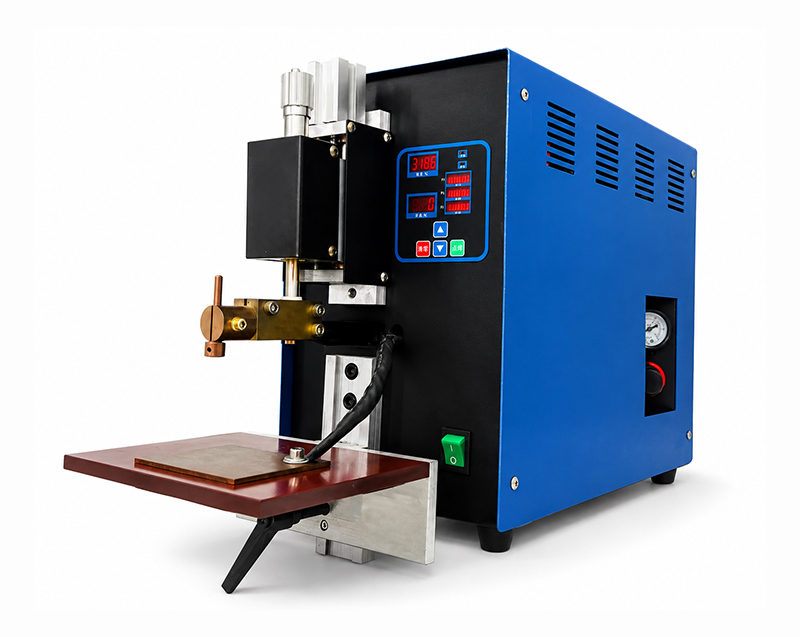
The MRX-DH650 Cylindrical Battery Negative Terminal Spot Welder is a precision welding system designed for the assembly of cylindrical battery cells. It is primarily used to join the negative battery shell with a conductive tab, providing a controlled welding process for cylindrical lithium-ion cells and other rechargeable battery formats.
Built around an AC pulse welding architecture and microcomputer-based control system, the MRX-DH650 provides stable welding output and flexible pulse configuration. The system allows operators to select single-pulse, double-pulse, or multi-pulse welding modes according to different material combinations and process requirements.
The equipment is particularly suitable for battery assembly environments where consistent weld positioning, controlled electrode force, and repeatable welding parameters are important. Its compact construction also makes it suitable for laboratory development, prototype production, and small-scale cylindrical cell manufacturing.
Key Specifications & Parameters
The MRX-DH650 provides a maximum output power of 10 KVA and operates from an AC 220V ±10% power supply. Its welding current setting is digitally adjustable from 00 to 99, providing operators with a convenient way to establish and reproduce welding conditions for different cell and tab combinations.
The required compressed-air pressure ranges from 0.3 to 0.7 MPa. The machine is designed to handle a range of welding tabs and sheets with thicknesses from approximately 0.03 mm to 0.25 mm, depending on the material and specific welding configuration.
The equipment measures approximately 500 × 300 × 470 mm and weighs about 29 kg, providing a relatively compact footprint for battery production workstations and laboratory environments.
Core Features
The MRX-DH650 uses microcomputer-based control to manage the welding process and improve operational consistency. Digital parameter adjustment allows key welding settings to be configured directly, reducing dependence on mechanical adjustment and making process setup easier to reproduce.
The pulse welding system supports single-pulse, double-pulse, and multi-pulse operation. This provides greater flexibility when working with different tab materials, thicknesses, and battery construction requirements.
The two welding electrodes feature independently adjustable pressure settings. This arrangement allows the operator to balance electrode force according to the welding position and material characteristics, helping maintain stable contact during the welding cycle.
A dedicated optical welding trigger is used to initiate the welding operation. The system is designed to provide convenient operation while reducing the need for frequent mechanical switch replacement during normal use.
The compact mechanical structure and carefully arranged welding assembly allow the MRX-DH650 to be integrated into work areas where installation space is limited. Its positioning mechanism is designed to support accurate tab placement on cylindrical cells during repeated assembly operations.
Main Functions
The primary function of the MRX-DH650 is to create spot welds between the negative shell of a cylindrical battery cell and its conductive tab. The controlled electrical pulse generates localized heat at the contact point, forming the required mechanical and electrical connection between the components.
The adjustable welding current and pulse configuration allow users to establish suitable welding conditions for different tab materials and thicknesses. This makes the equipment useful for process development as well as routine battery assembly operations.
The independent electrode-pressure adjustment provides additional control over the contact conditions during welding. Combined with digitally configurable welding parameters, this helps operators develop repeatable welding processes for cylindrical cell production.
The machine can also be used for prototype cell fabrication and process verification, allowing battery engineers to evaluate tab welding parameters before introducing the process into larger-scale manufacturing equipment.
Specific Application Scenarios
The MRX-DH650 is suitable for cylindrical lithium-ion battery assembly, particularly where a conductive tab needs to be attached to the negative cell shell. It can support development and production processes involving appropriately sized cylindrical rechargeable cells.
In battery research laboratories, the machine can be used to investigate welding current, pulse duration, electrode pressure, and tab thickness combinations. This allows engineers to establish suitable process windows during new cell development.
For prototype manufacturing, the MRX-DH650 provides a practical method for preparing cylindrical cells before further electrical testing, formation, or pack-level evaluation. Its digitally controlled welding parameters make it easier to reproduce selected welding conditions across multiple prototype samples.
The equipment can also be applied to nickel-cadmium and nickel-metal hydride battery assembly processes where suitable materials and welding configurations are used. This makes the platform useful for a broader range of rechargeable battery development projects.
The MRX-DH650 is also suitable for small-scale production environments that require dedicated cylindrical cell tab welding without the footprint and complexity of a fully automated battery assembly line.
Frequently Asked Questions
1. What is the MRX-DH650 designed to weld?
The MRX-DH650 is primarily designed to weld conductive tabs to the negative shells of cylindrical battery cells. It is suitable for selected lithium-ion, nickel-metal hydride, and nickel-cadmium battery assembly applications.
2. Is this machine suitable for cylindrical lithium-ion batteries?
Yes. The machine is specifically designed for cylindrical battery tab welding and can be used in cylindrical lithium-ion cell assembly and prototype development when the cell and tab configuration falls within the equipment's applicable range.
3. What welding modes are available?
The control system supports single-pulse, double-pulse, and multi-pulse welding. Different pulse configurations can be selected according to the material combination and welding process being developed.
4. Can the welding current be adjusted?
Yes. The welding current is digitally adjustable using a numerical setting range from 00 to 99, allowing operators to establish suitable welding conditions for different applications.
5. What thickness of welding tab can the MRX-DH650 handle?
The stated applicable range is approximately 0.03 mm to 0.25 mm for various welding sheets or tabs. The optimal setting depends on the specific material combination and welding requirements.
6. How is electrode pressure controlled?
The two welding electrodes have independently adjustable pressure settings. This enables operators to configure the electrode force according to the welding position and material characteristics.
7. Is the MRX-DH650 suitable for battery R&D?
Yes. Its digital parameter control and flexible pulse modes make it suitable for battery research, welding process development, prototype cell fabrication, and small-batch testing.
8. What power supply does the machine require?
The MRX-DH650 uses an AC 220V ±10% power supply and has a maximum output power of 10 KVA.
9. Does the machine require compressed air?
Yes. The specified input air pressure is 0.3–0.7 MPa. A suitable compressed-air supply should be provided according to the installation requirements.
MRX-DH650 for Cylindrical Battery Assembly
The MRX-DH650 provides battery manufacturers, research laboratories, and prototype developers with a dedicated solution for cylindrical cell negative-tab welding. By combining microcomputer control, adjustable pulse sequences, digital welding settings, and independently configurable electrode pressure, the machine offers the process flexibility needed for different cylindrical cell development requirements.
Manufactured by Shenzhen Mingrui Xiang Automation Equipment Co., Ltd., the MRX-DH650 is designed for practical battery assembly applications where controlled spot welding, compact equipment dimensions, and repeatable process settings are essential.



 Phone
Phone